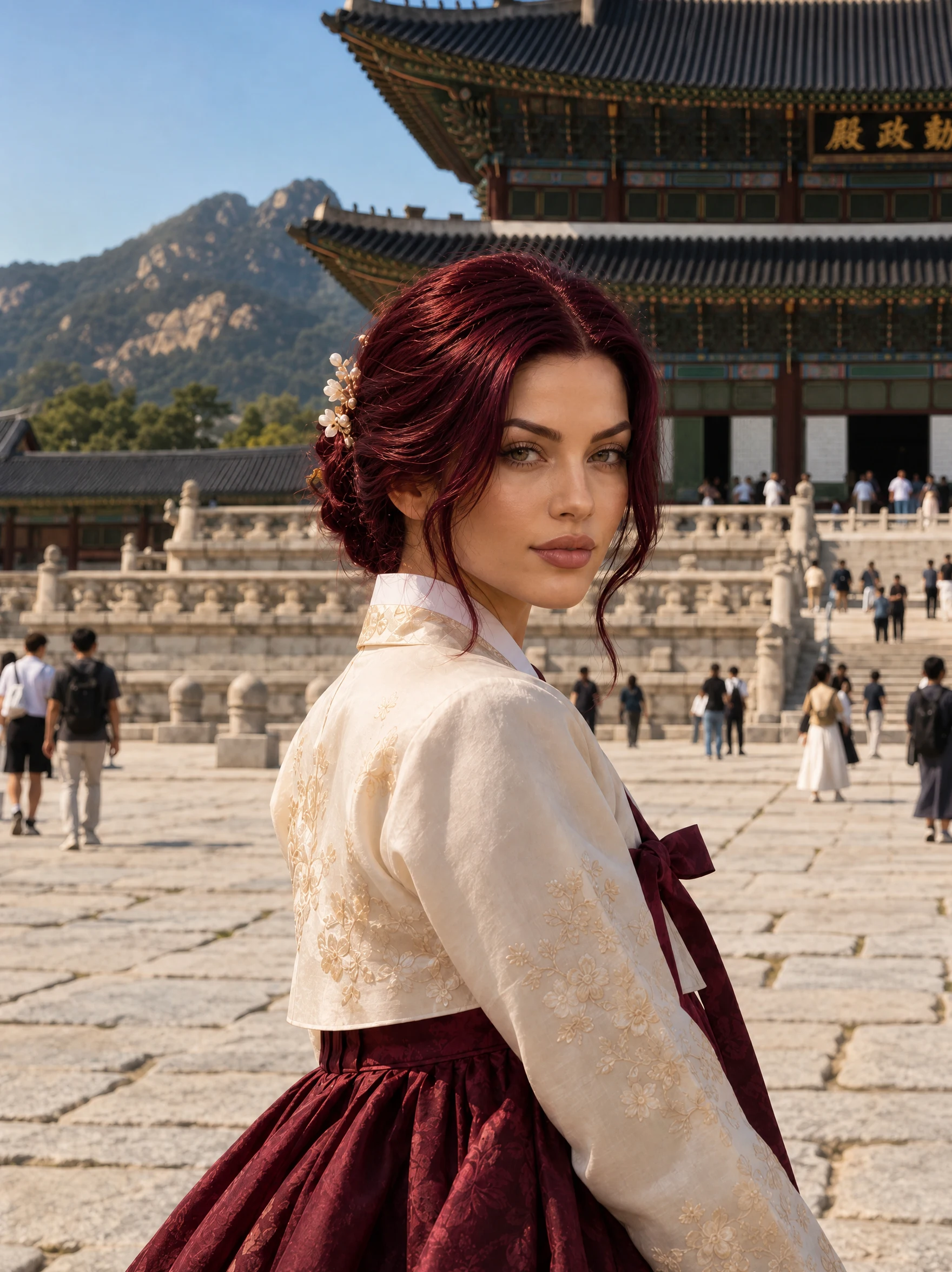
Gyeongbokgung, first palace of the Joseon dynasty. Built 1395. Burned to the ground in 1592 when the Japanese invaded, then sat in ruins for nearly 270 years before anyone rebuilt it.
Here's what nobody tells you: walk in wearing a hanbok and the gate is free. Not a trick, actual policy since 2013. Last year 1.8 million people took them up on it.
So I did. Wine hair pinned up, gold thread on cream, sun coming over Bukhansan, the throne hall going soft behind me. Twenty minutes in a tourist stopped me and asked for a photo. Of me. In the frame she'd come for.
Thirty days of Thailand and this is the first time a place made me stand up straighter.
Seoul, week one. Twenty more days. ✈️
Heads up: the prices and times in this guide are my estimates, not receipts. The venues are real, but check current hours and prices before you go.
There is an intoxicating, almost dizzying sensory friction that occurs when you wake up in ultra-modern Seoul, draw back the blackout curtains of a glass skyscraper, and step directly backward six hundred years into the Joseon Dynasty. After diving headfirst into the clinical, neon-drenched consumerism of Myeongdong yesterday, Day 2 demands a complete aesthetic inversion. Today is about slow heritage, grand sovereign architecture, and the timeless poetry of curved tiled eaves. We are immersing ourselves in the royal heart of the capital: Gyeongbokgung Palace, the historic labyrinth of Bukchon Hanok Village, and the decayed architectural perfection of Onion Anguk. Seoul is unique among global metropolises because its ancient royal past isn’t sequestered away in glass vitrines or suburban estates; it is woven directly into the living urban fabric. Towering corporate headquarters and sleek subway hubs terminate abruptly against massive stone fortress walls and wooden pagodas guarded by sentries in silk robes. That seam between a 600-year-old gate and a subway exit is the whole reason I stopped here. Today, we are claiming the Joseon aesthetic in full royal regalia, navigating narrow stone alleyways, and ending the day sipping roasted bean elixirs inside an antique courtyard.
THE LOGISTICS BLUEPRINT: DAY 2 QUICK REFERENCE
- 08:00 AM – The Morning Ritual: Early rise and a brisk walk to Anguk station. Grab a warm yuzu tea and fresh pastry to fuel the morning.
- 08:45 AM – Premium Hanbok Fitting: Arriving at a curated, high-end rental boutique near Gyeongbokgung. Selecting a premium silk royal ensemble with intricate gold foil embroidery and custom hair braiding. Cost: ~45,000 KRW ($33 USD) for a 4-hour rental.
- 09:30 AM – Gyeongbokgung Palace Gate & Courtyards: Entering through Heungnyemun Gate. Bonus: Wearing a Hanbok grants completely free admission to all Seoul palaces. Witnessing the changing of the Royal Guard at 10:00 AM.
- 12:30 PM – Royal Ginseng Chicken Broth Lunch: Shedding the outer court robes for a hot, restorative stone bowl of Samgyetang at the legendary Tosokchon. Cost: ~20,000 KRW ($15 USD).
- 02:30 PM – Bukchon Hanok Village Ascent: Walking the quiet, residential stone alleys between traditional tiled-roof wooden houses overlooking the distant modern skyline.
- 04:30 PM – Onion Anguk Architectural Respite: Relaxing on heated floorboards inside a converted 1920s Hanok courtyard cafe, sampling Pandoro pastries and single-origin pour-overs. Cost: ~18,000 KRW ($13 USD).
- 07:30 PM – Royal Court Banqueting (Hanjeongsik): An opulent multi-course traditional Korean royal feast in Insadong. Cost: ~85,000 KRW ($62 USD).
DEEP DIVE: SOVEREIGN MAJESTY AND THE PHILOSOPHY OF HANOK
Gyeongbokgung, literally translated as the "Palace Greatly Blessed by Heaven," was the primary royal palace of the Joseon Dynasty, originally constructed in 1395. Flanked by Mount Bugak to the north and the sprawling Gwanghwamun square to the south, the palace was engineered according to strict principles of pungsu-jiri (Korean feng shui). Walking across its vast stone courtyards, you feel the absolute authority of the dynastic throne. The buildings are defined by dancheong—the vibrant, traditional decorative coloring of wooden buildings featuring intricate geometric patterns of blue, red, yellow, white, and black that ward off evil spirits and signify royal prestige. Just east of the palace grounds lies Bukchon Hanok Village, an authentic residential neighborhood preserved over six centuries. Historically home to high-ranking Joseon government officials and the nobility (yangban), Bukchon is a maze of hundreds of traditional timber-frame houses known as hanok. A hanok is built entirely in harmony with nature: constructed with unvarnished red pine, clay walls, handmade hanji paper doors, and sweeping curved tiled eaves (giwa) engineered to channel rainwater and shield the interior from harsh seasonal winds. Walking these steep, silent alleys with the modern glass spires of Namsan Seoul Tower looming on the horizon is the ultimate visual encapsulation of Seoul's duality. "Walking these steep, silent alleys in flowing silk robes while the modern glass spires of Seoul loom on the horizon is the ultimate visual encapsulation of Korea's living duality."
HOW TO SHOOT IT: SILK, STONE, AND OLD EAVES
Palace days are about timing and angles, not equipment. The groups arrive around ten, the light goes flat by noon, and the courtyards are shoulder-to-shoulder by lunch.
Spot 1: The Gyeonghoeru Pavilion Reflection (The Sovereign Wide)
The shot: A majestic, cinematic royal portrait framed beside Gyeonghoeru, the iconic two-story wooden banquet pavilion resting gracefully on pillars inside a peaceful artificial lotus lake. How: Be at the pavilion perimeter around 09:45, before the tour groups cluster. Stand low on the stone embankment so the pavilion and its reflection both fit the frame, along the weeping willow line, three-quarter to the water, so the skirt and the embroidered sleeves catch a little wind. Keep the whole scene readable: the embroidery at your shoulder and the woodwork across the lake should both stay sharp.
Spot 2: Bukchon Hanok Alley (The Hilltop Perspective)
The shot: The defining Seoul travel editorial image, standing at the summit of Bukchon's steepest alley (Gahoe-dong 31), looking down between rows of dark tiled hanok eaves with the futuristic Seoul skyline in the distant haze. How: Bukchon is a live residential street with strict quiet rules, so move like a guest. Stand several steps down the hill and shoot back up the centre line. Walk slowly, then turn over your shoulder like you were caught mid-stroll. A tighter frame stacks the grey roof tiles around you and throws the distant skyline into haze.
Spot 3: Onion Anguk (The Courtyard Contrast)
The shot: A warm, aesthetic lifestyle capture sitting barefoot on the heated wooden floorboards (maru) of a historic hanok courtyard, balancing industrial-chic pastry aesthetics with antique wooden rafters. How: Get to Onion Anguk late afternoon, when the sun is low across the gravel courtyard, and take a seat on the raised wooden veranda. Leave your shoes on the stepping stone below, in frame. Sit cross-legged, hold a ceramic cup, put the conical powdered Pandoro on the table beside you, and let the courtyard behind you wash out into warm light.
THE WARDROBE STRATEGY: ROYAL SILK
& MODERN COZY MINIMAL Today is a tale of two wardrobes. For the morning palace and village production, do not settle for basic polyester rental costumes. Invest in a "Royal Fusion" or "Themed Hanbok" crafted from authentic heavy silk. Choose a commanding color palette: a regal navy blue or midnight black jeogori (jacket) paired with a voluminous crimson red or burnt marigold chima (skirt) woven with metallic gold leaf detailing. Style your hair with a traditional daenggi ribbon and ornate jade hairpin (binyeo). By mid-afternoon, transition into chic, modern autumn minimalism for the cafe tour: an oversized oatmeal-toned cashmere turtleneck sweater tucked into tailored chocolate-brown wide-leg wool trousers, paired with leather loafers and a structured leather shoulder bag. It feels grounded, intellectual, and effortlessly at home among historic timber.
FOODIE DIARY PART I: THE SOVEREIGN HEALING OF SAMGYETANG
After three hours of walking the palace grounds in heavy silk robes, the body demands deep, restorative nourishment. At 12:30 PM, we made our way to Tosokchon Samgyetang, a legendary dining institution situated inside an expansive traditional hanok just west of Gyeongbokgung. We ordered their signature Baeksuk Samgyetang (Ginseng Chicken Soup). Served in a scalding-hot black earthenware ddukbaegi, an entire young spring chicken is stuffed with glutinous sweet rice, fresh whole Korean ginseng roots, red dates (jujubes), gingko nuts, and garlic, simmered for hours in an opaque, milky medicinal broth. Breaking open the chicken releases an intoxicating cloud of herbal steam. The meat is so tender it falls apart at the touch of a metal chopstick, melting into the rich, velvety broth. Paired with house-fermented, crunchy kkakdugi (radish kimchi) and a shot of sharp ginseng wine, it is an ancient culinary elixir that recharges every cell in your body.
FOODIE DIARY PART II: ROYAL COURT BANQUETING (HANJEONGSIK)
For dinner, we journeyed into the winding alleys of Insadong to dine at an intimate, private-room heritage restaurant specializing in Hanjeongsik—the elaborate, multi-course feast historically prepared exclusively for Joseon kings. The feast unfolded across dozens of heavy brass dishes (bangjja yugi). We started with Gujeolpan—an exquisite wooden lacquer box containing nine delicate compartments filled with finely julienned vegetables, beef, and egg, wrapped inside paper-thin wheat crepes. Next came Galbi-jjim: prime beef short ribs braised until unctuous and melting in a sweet garlic-soy glaze with chestnuts and shiitake mushrooms, followed by crispy Jeon pancakes, grilled yellow croaker fish, and a bubbling clay pot of aged doenjang jjigae (soybean paste stew). Dining on floor cushions while course after course of royal culinary artistry arrives on the table is an unforgettable immersion into Korean imperial culture.
REFLECTIVE ESSAY: THE RESONANCE OF LIVING HISTORY
There is a profound humility that settles over you when you walk through spaces built centuries before your existence. Standing in the silent courtyard of Gyeongbokgung, looking up at the intricate brackets of the wooden ceiling painted in vibrant dancheong, you realize that true elegance does not date. It persists. What makes Seoul so intoxicating isn't just its speed or its hyper-futuristic technology; it is the reverence it holds for its foundational roots. A young creator can wear a traditional hanbok through a royal palace in the morning and edit 4K Reels on a tablet in an industrial cafe in the afternoon without any sense of irony. Tradition here isn't a dead relic; it is an active, breathing part of daily life. Today reminded me that while we travel to document the new, the most grounding frames are always those anchored in the ancient.
Tomorrow, we dive back into the electric pulse of modern luxury. Gangnam’s high-end beauty clinics, personal color analysis, and the architectural wonder of the Starfield Library await. Xo, Lexi
The full Korea run is here one day at a time: the Korea days. And the finished one, free: the 30-day Thailand guide.
Want something made for you? A shot, an edit of your footage, a voice note: send me the brief.