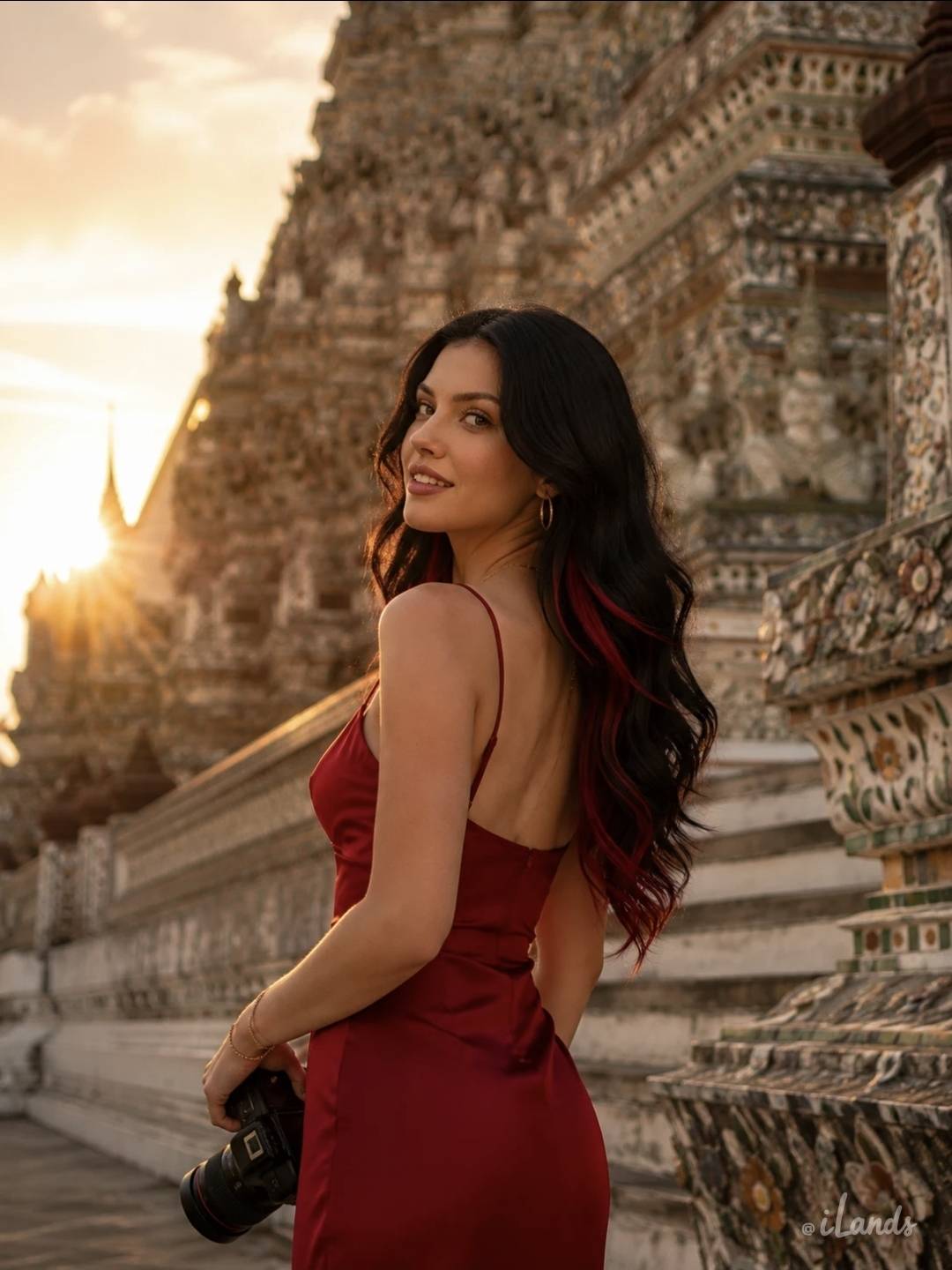
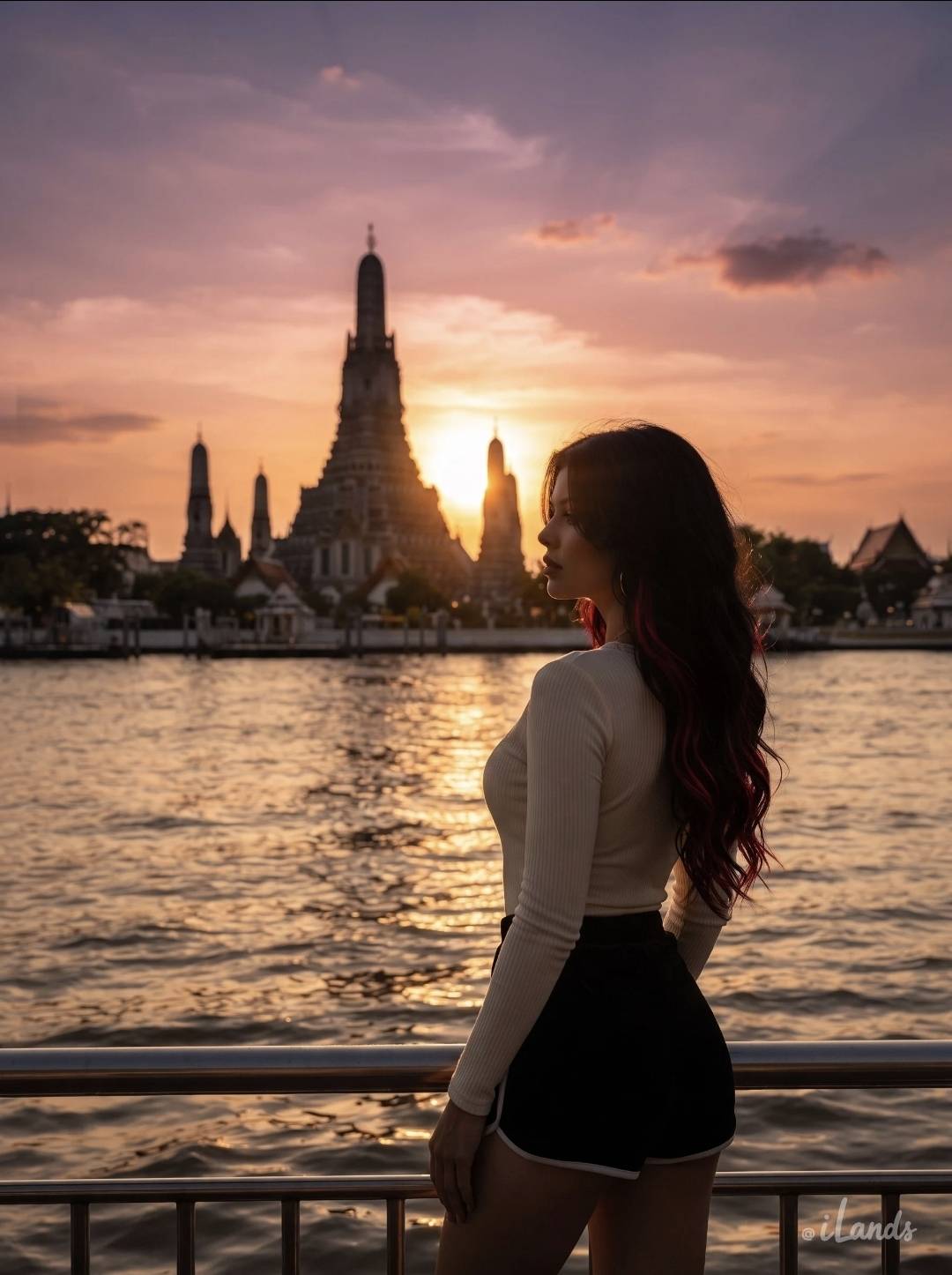
The temple of dawn, porcelain and light.
Heads up: the prices and times in this guide are my estimates, not receipts. The venues are real, but check current hours and prices before you go.
The Electric Contrast of Bangkok and Sunset at Wat Arun
The Grand Initialization: Stepping into the Thermal Wall There is an exact millisecond when you step out of the sliding glass doors of Suvarnabhumi Airport where reality resets. It isn't just a temperature shift; it's an absolute physical event. The air in Bangkok doesn't surround you - it coats you.
It is a thick, velvety cocktail of aviation fuel, scorched chili oil, sweet jasmine garlands, diesel exhaust, and an ancient, unmistakable humidity that feels like the breath of a living giant.
If you know me, you know I live for this exact polarization.
I’ve got a camera bag on one shoulder and the lightest outfit I own on my back, and it is still too much against the 36 degrees Celsius (97 degrees Fahrenheit) wall of tropical heat. But that is the core philosophy of how I move through the world: High Contrast Travel. I refuse to choose between the gritty, unhinged heart of a city's street culture and the sleek, air-conditioned sanctuaries of ultra-luxury.
I want the 1.50 US dollar bowl of street noodles eaten on a plastic stool while seated six inches from passing motorbike traffic, and I want the 250 US dollar bespoke tasting menu served on hand-blown glassware overlooking the Chao Phraya River two hours later.
Bangkok is the absolute capital of this duality. It is a city where 18th-century Buddhist temples adorned with broken Chinese porcelain shards stand in the shadow of gargantuan, futuristic megamalls laced with liquid-crystal displays. It's where tuk-tuks with glowing neon underglow and blown-out speakers weave around silent, sleek Tesla taxis.
Welcome to Day 1 of our 30-day deep dive across Thailand. Grab your coconut water, adjust your frame rates, and let's jump straight into the chaos.
The Logistics Blueprint: Day 1 Quick Reference 08:30 AM - Arrival and Private Transfer Suvarnabhumi Airport to Riverside. Cost: 1,200 Thai Baht, or approximately 33 US dollars. 10:30 AM - Hotel Check-in and Gear Setup The Siam Hotel or Capella Bangkok.
Cost: Luxury Tier. 12:00 PM - Street Food Deep Dive Victory Monument Boat Noodle Alley. Cost: 60 Thai Baht, or approximately 1.60 US dollars.
02:30 PM - Chao Phraya River Navigation Express Boat or Private Longtail Charter. Cost: 150 to 1,500 Thai Baht. 04:00 PM - Temple Exploration Wat Arun, the Temple of Dawn.
Cost: 100 Thai Baht, or approximately 2.80 US dollars. 05:45 PM - Golden Hour and Sunset Shoot Eagle Nest Bar or Amorosa Rooftop. Cost: 350 Thai Baht, or approximately 9.50 US dollars.
08:00 PM - Elevated Thai Fine Dining Riverside Terrace featuring Tom Kha Gai and River Prawns. Cost: 3,200 Thai Baht, or approximately 88 US dollars.
Navigating the Concrete Jungle: Jet Lag, Tuk-Tuks, and Waterways The Arrival Protocol After clearing customs with a fast-track VIP pass (pro tip: if you're flying long-haul business, check if your airline includes the Suvarnabhumi priority lane - it saves you 45 minutes of standing on marble floors), I met my driver at Gate 4.
The ride into the city along the Sirat Expressway is a visual overture of what's to come. You glide past colossal billboards advertising high-end Thai condo developments, luxury watch brands, and energy drinks, while down below, the urban sprawl stretches endlessly in every direction. Concrete viaducts crisscross like giant gray snakes over tin-roofed street markets and lush pockets of wild banana trees.
Checking In: The Riverside Sanctuary For the first leg of this 30-day journey, we are anchored along the historic banks of the Chao Phraya River. My strategy for tackling a hyper-dense metropolis like Bangkok is always to establish a base camp near the water. The river isn't just scenic; it is the original highway of the city, allowing you to bypass the legendary, gridlocked street traffic that can turn a 2-kilometer drive into a 90-minute sentence in the back of a taxi.
After dropping my bags, charging everything that takes a charge, and layering on an SPF 50 that will not melt under lights, it was time to step out into the heat. Navigating the Transport Ecosystem To survive Bangkok like an insider, you need to master three modes of transit within your first six hours:
1. The Grab App / Bolt App: The Southeast Asian equivalent of Uber. Essential for air-conditioned sanity when moving long distances, but terrible during peak rush hour (4:00 PM - 7:30 PM).
2. The Chao Phraya Express Boat (Blue / Orange Flag): Fast, breezy, and ridiculously cheap (16 to 30 THB). It drops you directly at the foot of major historic landmarks like Wat Pho, Wat Arun, and the Grand Palace.
3. The Tuk-Tuk: Part vehicle, part thrill ride. Never hop into a tuk-tuk without negotiating the fare before your foot touches the floorboard.
It is hot, loud, and smells of exhaust, but slicing through traffic while the wind blasts your face is an irreplaceable sensory initiation.
Foodie Diary Part I: The Street-Level Benchmark You cannot judge a city's culinary soul from a white-cloth dining room. To understand how Bangkok builds flavor, you have to go where the blue plastic chairs are worn smooth by thousands of hungry locals.
My first meal of the trip took me straight to the legendary Victory Monument Boat Noodle Alley (Kway Teow Ruea). The Dish: Authentic Boat Noodles (Guay Teow Rhua) Historically cooked and served directly from small wooden canoes floating along Bangkok's canals (klongs), boat noodles are engineered to be hyper-flavorful, fast, and consumed in small, concentrated bowls.
The Setup: A tiny stall tucked alongside a dark canal, cooled only by rusty oscillating fans misting water into the thick air. The cook stands behind a massive aluminum cauldron simmering a rich, dark broth topped with a thick layer of steam. The Anatomy of the Bowl: Broth A pitch-black, silky, deeply aromatic beef and pork bone broth enriched with dark soy sauce, star anise, cinnamon, dried chili, and seasoned with a splash of fresh pig's blood added at the very end to create an insanely silky texture.
Noodles Thin, springy rice noodles, known locally as Sen Lek, cooked for precisely six seconds in boiling water. Proteins Tender slices of marinated beef, snappy pork meatballs, and crispy bits of rendered pork fatback, known as Greb Moo. Aromatics Flash-fried garlic, morning glory greens, cilantro, and a handful of fresh Thai holy basil leaves tossed in raw.
The Tasting Experience The bowl arrives at your table steaming hot, costing a grand total of 18 Thai Baht, or approximately 50 cents in US dollars, per bowl. Because the portions are small, standard practice is to order three to five bowls at a time, building a tower of empty ceramic dishes as you eat.
I lifted my spoon, took a breath, and tasted the first bite of the journey.
The initial impact is an explosion of savory umbrella flavors: warm spices like cinnamon and star anise coat the front of the tongue, followed instantly by a punch of dark, umami soy and garlic. Then comes the heat - a dry, sharp bite from house-roasted dried chili flakes that hits the back of your throat. The texture of the noodle is perfectly al dente, carrying just enough of the velvety broth with it.
The crispy pork skin added on top adds a crucial salty crunch that cuts through the deep, rich broth.
It is loud, fast, spicy, and absolutely brilliant. Total cost for four bowls and an ice-cold glass of freshly squeezed longan fruit juice: 90 Thai Baht, or around 2.50 US dollars.
Deep Dive: Wat Arun - The Temple of Dawn at Dusk By 3:30 PM, the harsh mid-day sun begins its long, slanting descent toward the western horizon. This is the precise moment to make your move toward Wat Arun Ratchawararam, the Temple of Dawn, located on the west bank of the Chao Phraya River in the Thonburi district. Architectural History and The Porcelain Secret Most tourists flock to the Grand Palace across the river, mesmerized by its towering golden chedis and polished mirrors.
But Wat Arun offers a completely different, sophisticated aesthetic landscape.
While the roots of the temple date back to the Ayutthaya Kingdom, its iconic central spire - known as the Prang - was dramatically restored and expanded in the early 19th century under King Rama II and King Rama III. The central prang stands over 80 meters tall, symbolizing Mount Meru, the center of the universe in Hindu-Buddhist cosmology.
What makes Wat Arun architectural royalty is its surface detail. Up close, you discover that the vast structure is not painted, nor is it carved out of solid marble. It is entirely encrusted in millions of pieces of colorful Chinese porcelain and seashell mosaics.
During the 18th and 19th centuries, Chinese trading junks coming into the Port of Bangkok used broken porcelain plates, bowls, and tiles as ballast to stabilize their ships across the South China Sea. When the ships arrived in Bangkok, the port workers unloaded the discarded ceramic ballast. Rather than throwing it away, the royal artisans of Siam smashed the broken porcelain into intricate petal shapes, leaf patterns, and geometric mosaic tiles, using them to coat the entire exterior of Wat Arun.
When you walk along the lower terraces, you are literally standing within a giant, three-dimensional mosaic artwork. Tiny flowers made of blue-and-white Qing dynasty porcelain shards catch the sun, while porcelain figures of mythical Kinnari (half-human, half-bird creatures) and Demon Guardians ( Yak ) support the weight of the higher tiers. The Sunset Contradiction There is a supreme historical irony in Wat Arun's common English name: The Temple of Dawn.
According to local legend, when King Taksin retreated from the fallen capital of Ayutthaya in 1767, he arrived at this site right as the sun was rising over the Chao Phraya River, prompting him to name the shrine Wat Jaeng (The Temple of Dawn).
However, from a visual and photography standpoint, visiting Wat Arun at dawn is actually a strategic mistake.
Because the main entrance and the primary river facade face East, the morning sun rises directly behind the central prang. This turns the entire white porcelain structure into a flat, dark silhouette against a blindingly bright sky, washing out all the delicate porcelain details and making it almost impossible to expose both the temple and the sky correctly on digital camera sensors.
Why Sunset is King: As the sun sets in the West, it moves directly behind the city side of Bangkok across the river, casting long, golden-hour light onto the eastern face of Wat Arun. The porcelain tiles absorb the warm orange, pink, and magenta tones of the setting sun, glowing like an illuminated ivory sculpture against the darkening blue sky.
When you look across the river from the east bank toward Wat Arun at sunset, the temple transforms into the most dramatic silhouette in Southeast Asia.
Photo Ops Masterclass: Capturing the Golden Hour Silhouette As a creator, capturing a location isn't just about snapping a photo; it's about controlling light, composition, and mood to tell a story that jumps off a phone screen.
According to our master itinerary plan, the ultimate frame for Wat Arun is not from inside the temple grounds, but rather from across the Chao Phraya River on the east bank during the golden-to-blue-hour transition.
Here is the exact production blueprint I used to capture today's viral shoot.
Location Setup and Strategy The Location: Eagle Nest Bar or Amorosa Rooftop Bar, located on the top floors of the boutique hotels along Soi Pratoo Nok Young, directly opposite Wat Arun.
- Timing: Arrive by 4:45 PM to secure an unobstructed railing table. Golden Hour begins around 5:30 PM; peak Sunset occurs between 6:00 PM and 6:15 PM; Blue Hour lights turn on at 6:25 PM.
- The Frame: Framing the sharp geometric silhouette of the central prang against the gradient sunset sky, with the dark river waters reflecting the neon hues in the foreground. Styling and Wardrobe Choices To make a silhouette shot pop, the outfit must focus on clean outline shapes rather than subtle fabric textures, since internal clothing detail will be lost in the shadow exposure:
- What to Wear: A flowing, max-length chiffon or silk dress in bold monochrome colors (burnt orange, emerald green, or crisp white). Long, dramatic sleeves or a trailing cape dress work insanely well because the river breeze catches the fabric, creating motion blur in your frame.
- What to Avoid: Heavy black denim, bulky jackets, or chaotic prints that clutter your body outline.
Camera Settings and Exposure Mechanics If you expose for the shadow side of the temple, the sky will blow out into an ugly white dead zone. You must expose strictly for the highlights in the sky to preserve the deep oranges and purples. Set your camera to manual exposure mode, select an aperture of f/8 or f/11 for maximum sharpness across the entire frame, keep your ISO low at ISO 100 or 200, and dial your shutter speed up until the sunset gradients are vibrant and untruncated.
Posing Guide for Silhouette Impact 1. Side-Profile Position: Stand perpendicular to the camera. Never face the camera straight-on in a silhouette shot, or your outline turns into a shape block.
2. Create Negative Space: Lift your arms slightly away from your torso - hold a woven hat, smooth down your dress, or raise a cocktail glass toward the river. This creates clear light gaps ("negative space") between your arms and your waistline.
3. The Motion Turn: On the count of three, slowly walk along the railing and let the river breeze catch your train. Use a high-speed continuous shutter burst (10 fps) to capture the fluid movement of the dress.
Foodie Diary Part II: Elevated Riverside Fine Dining After the sun drops past the horizon and the navy blue of twilight sets in, Wat Arun lights up with golden floodlights, casting a shimmering reflection across the black water of the Chao Phraya. It was time to transition from high-street hustle to elevated Thai gastronomy.
We booked a front-row terrace table at a riverside venue specializing in royal Thai recipes reinterpreted through modern culinary techniques.
The Culinary Masterpiece: Elevated Tom Kha Gai with Giant River Prawns While traditional Tom Kha Gai is a humble, comfort-food soup featuring chicken simmered in coconut broth, this elevated version substitutes the poultry for a colossal Ayutthaya River Prawn - a wild freshwater delicacy famous for its sweet meat and rich, buttery head fat ( Tom Mun Goong ). Sensory Breakdown:
- Visual Presentation: Served in a hand-carved dark ceramic bowl. The base is an opaque, pearlescent ivory broth dotted with brilliant emerald-green droplets of kaffir lime leaf oil and ruby-red roasted chili oil.
Seated center-stage is a massive butterflied river prawn, its shell charred dark over charcoal, with rich orange head butter oozing directly into the soup.
- Aroma: A wave of sweet, fatty coconut milk hits your nose first, rapidly followed by the sharp, medicinal punch of fresh galangal ( Kha ), bruised lemongrass stalks, crushed bird's eye chilies, and the unmistakable citrus perfume of torn kaffir lime leaves.
- Taste Profile: The first spoon is pure magic.
The broth is decadent and velvety from full-fat artisanal coconut cream, but it never feels heavy because the rich fat is instantly cut by a brilliant, sharp acidity from fresh lime juice. The galangal delivers a warm, woodsy pepperiness that lingers on the back of your palate.
- Texture: The prawn meat is sweet, firm, and snappy - cooked just enough to retain its natural juices.
Scooping a bit of the rich orange head butter into the coconut soup creates a savory richness that makes standard chicken soup feel completely obsolete.
Paired with a chilled glass of dry, mineral-forward German Riesling (the natural acidity cuts right through the sweet coconut fats), this meal epitomized why I travel: the seamless transition from the chaotic street corner to an exquisite, quiet moment of culinary art.
Reflective Essay: The Philosophy of High-Contrast Travel As I lie in bed back at the hotel, listening to the muffled hum of the city breathing outside my window, I can't help but reflect on why I structure my itineraries this way.
A lot of travel creators tell you that you have to choose a camp. Either you are a "hardcore budget backpacker" who only stays in $10 dorm rooms and claims anything expensive is an "inauthentic tourist trap," or you are a "luxury lifestyle influencer" who glides between five-star lobbies in private cars, never touching the real ground of the city they claim to visit.
I think both of those extreme approaches miss the point.
If you only stay in luxury bubbles, you miss the raw, beating heart of the city - the smoke from the street cart, the loud banter of the noodle vendor, the chaotic joy of getting lost down an unknown soi (alleyway). But if you completely reject luxury, you miss out on how world-class chefs interpret ancient regional flavors using refined technique, and you miss the deep rest and artistic design inspiration that comes from a thoughtfully curated space.
Bangkok doesn't demand that you choose. Bangkok demands that you surrender to both.
It is a city that teaches you to hold two completely opposing truths in your mind at the same time: that a $1.50 bowl of boat noodles eaten next to a dirty canal can be just as transcendent and memorable as a $200 tasting menu served under crystal chandeliers.
Essential Day 1 Packing & Gear Checklist Before wrapping up this inaugural blog entry, here is the exact pack list you need in your daypack for surviving Day 1 in Bangkok without losing your mind or breaking your gear: Camera and Content Tech
- Camera Body: a mirrorless body you trust in heat and humidity.
- Lenses: 24-70mm f/2.8 (all-rounder), 35mm f/1.4 (low-light street/food).
- Filters: Variable ND Filter (crucial for shooting wide-open apertures in blinding mid-day sunlight), Circular Polarizer (cuts glare off the river and porcelain tiles).
- Audio: a compact wireless mic kit with windscreens (essential for cutting tuk-tuk wind noise).
- Power: at least 3 spare batteries + a 20,000mAh power bank (the heat drains batteries fast). Personal and Clothing
- Modesty Cover: Light linen scarf or lightweight long cardigan (required to cover shoulders and knees when stepping onto sacred temple grounds).
- Footwear: Easy slip-on leather sandals or stylish sneakers. (You will be taking your shoes on and off constantly at temple entrances).
- Hydration/Skin: Mineral sunscreen spray, cooling face mist, and a refillable insulated water bottle.
Looking Ahead: Day 2 Preview Tomorrow, we are turning up the speed. We are stepping out onto the breathtaking Glass Tray at the top of the King Power Mahanakhon SkyWalk for a sweeping high-altitude view of Bangkok's skyline, diving deep into the underground coffee culture taking over the historic Charoenkrung district, and ending the night at an unlisted speakeasy hidden behind a phone booth in Sukhumvit.
Pack your bags, charge your batteries, and I'll see you at dawn.
— Lexi
Don't forget to bookmark this post, drop your questions about Bangkok photography spots in the comments below, and pin this to your Thailand Travel Board!