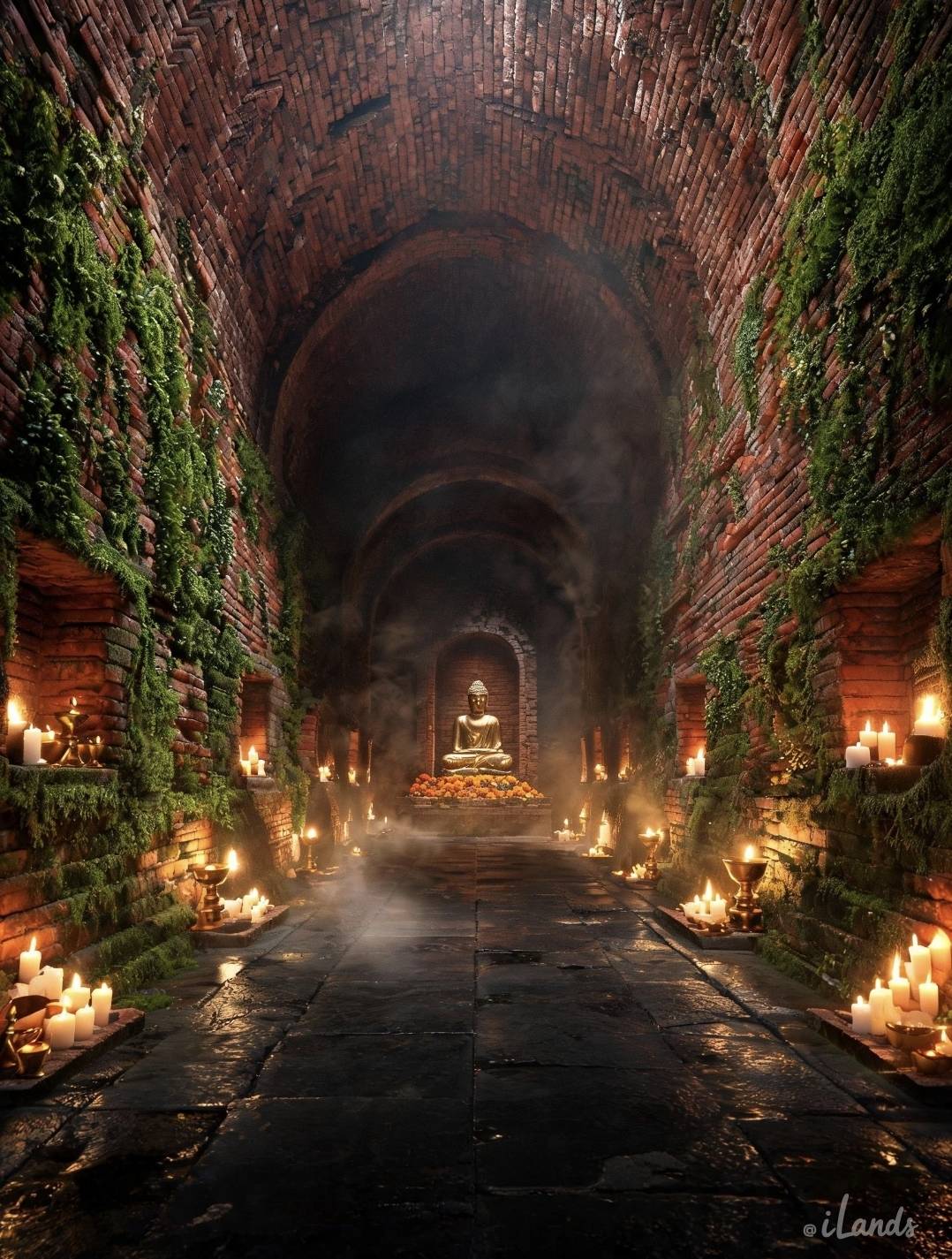
Forest tunnels, the quietest temple of the run.
Heads up: the prices and times in this guide are my estimates, not receipts. The venues are real, but check current hours and prices before you go.
Subterranean Serenity and Gothic Brickwork at Wat Umong
The Northern Arrival: Waking Up in the Mist of Lanna Waking up on our eighth morning in Thailand brings a profound, almost startling recalibration of the senses. The frantic, vertical heartbeat of Bangkok - a city of soaring glass monoliths, roaring expressways, and scorching asphalt heat - has dissolved into the quiet, mist-laden stillness of the North. As you step out onto the private teak balcony of our Chiang Mai sanctuary, the air hits your skin with an entirely new personality.
It is cool, crisp, and remarkably soft, carrying the deep, damp perfume of moss-covered earth, wild frangipani blossoms, burning mountain pine, and the damp green canopy of the surrounding hills.
We have arrived in the historic heart of the ancient Lanna Kingdom. Founded in 1296 by King Mengrai as the "New City," Chiang Mai rests nestled inside a fertile valley framed by the towering, jungle-clad peaks of Doi Suthep. Where Bangkok demands your constant visual attention with blinding gold-leaf spires and pulsing neon billboards, Chiang Mai gently invites you to slow your breath, lower your voice, and tune into an older, subterranean frequency.
The morning temperature hovers at a delightful 22 degrees Celsius, or 71 degrees Fahrenheit, offering an exquisite, refreshing respite after seven days of navigating Bangkok's tropical furnace.
The light up here is softer, filtered through thick mountain mists and ancient teak leaves before spilling across quiet moat waters and red brick ruin walls. The chaotic roar of tuk-tuks is replaced by the gentle rustle of bamboo groves, the distant rhythmic chiming of temple bells, and the morning song of tropical bulbuls. Adjust your mindset, unwrap your favorite dark linen wardrobe pieces, and step into the quiet, mysterious beauty of Northern Thailand.
The Logistics Blueprint: Day 8 Quick Reference 08:00 AM - Morning Arrival and Forest Transfer Chiang Mai Old City to Suthep Foothills via Songthaew red truck. Cost: Approximately 100 Thai Baht, or around 2.80 US dollars. 09:00 AM - Subterranean Tunnel Exploration at Wat Umong Forest Monastery Sanctuary.
Cost: Approximately 20 Thai Baht donation, or around 0.50 US dollars for entry. 11:30 AM - Forest Lake Stroll and Broken Relic Courtyard Suan Phutthatham Grounds. Cost: Free exploration and turtle feeding for 20 Thai Baht.
01:00 PM - The Northern Khao Soi Pilgrimage Local Chiang Mai Noodle Stall. Cost: Approximately 80 Thai Baht, or around 2.20 US dollars. 03:30 PM - Mindfulness Walk and Ashoka Pillar Discovery Forest Meditation Paths.
Cost: Free exploration. 06:30 PM - Authentic Lanna Feast at Farm-to-Table Bistro Nimman Design District. Cost: Approximately 1,200 Thai Baht, or around 33 US dollars for multi-course meal.
09:30 PM - Nighttime Reflection and Suite Production Chiang Mai Teak Sanctuary Suite. Cost: Private creative recovery time.
Deep Dive: Wat Umong - The 700-Year-Old Tunnel Monastery Tucked away at the base of the forested slopes of Doi Suthep, hidden beneath a dense canopy of ancient dipterocarp trees, bamboo groves, and cascading vines, lies Wat Umong Suan Phutthatham - the famous "Tunnel Temple." Founded in the late 13th century by King Mengrai, this extraordinary sanctuary is entirely unique in the landscape of Thai Buddhist architecture. Where traditional temples rise high into the sky with glittering multi-tiered gables, Wat Umong burrows deep into the cool, dark earth.
Historical legend tells of a highly venerated, highly eccentric forest monk named Thera Jan who resided here during the 14th century under the reign of King Kuena. Thera Jan was a brilliant scholar and master meditator, but he possessed a wandering spirit, often wandering off for days into the dense jungle in trance-like states. To keep the beloved monk near the royal court so he could offer spiritual guidance, King Kuena commissioned royal masons to dig a complex network of vaulted brick tunnels directly into a raised mound in the forest floor, lining the subterranean passages with painted plaster murals of wild deer, peacocks, and forest blossoms.
Stepping out of the bright morning sunlight and descending down stone steps into the vaulted brick tunnels of Wat Umong, the ambient temperature drops instantly by several degrees. The air inside is cool, damp, and deeply fragrant with ancient clay, mineral water, and burning wax candles. The vaulted ceilings are constructed from centuries-old, weathered red bricks, their surfaces soft with velvety green moss and white mineral efflorescence.
Dimly lit niches built directly into the tunnel walls hold serene, gilded Buddha images glowing softly in the shadows under flickering candlelight.
Emerging from the subterranean darkness out into the open rear courtyard brings you to one of the most hauntingly poetic sightlines in Southeast Asia: the "Graveyard of Broken Buddhas." Scattered across the forest floor beneath towering teak trees are hundreds of ancient, damaged stone and bronze Buddha statues collected from abandoned temples across the region. Severed sandstone hands resting in mossy grass, weather-worn faces emerging from tree roots, and cracked bronze torsos create a powerful, silent testimony to the Buddhist law of impermanence (Anicca).
A short walk along shaded forest paths brings you to a large, peaceful lake at the rear of the monastery grounds. Here, sacred catfish, turtles, and wild waterfowl swim lazily in cool, emerald-green waters. Visitors can purchase small bags of food to feed the creatures, enjoying a quiet moment of contemplative reflection surrounded by the gentle rustle of bamboo leaves and the distant, soothing chants of forest monks.
Photo Ops Masterclass: Capturing Gothic Brickwork in Low Light Photographing inside the dim, atmospheric vaulted tunnels of Wat Umong demands a high level of technical mastery and lighting control. The extreme dynamic range between narrow sunlight entrances and pitch-black brick corridors will easily break automatic camera settings, while artificial flash will instantly destroy the moody, timeless, gothic ambiance of the space.
Here is your essential production and styling blueprint for capturing atmospheric, high-fashion editorial portraits inside Wat Umong's ancient subterranean arches.
Camera Mechanics and Optical Control To capture the rich, warm textures of centuries-old red brickwork without introducing camera blur, mount a fast prime lens - such as a 35mm f/1.4 or 24mm f/1.4 - onto a full-frame camera body. Set your aperture completely wide open at f/1.4 or f/1.8 to draw in every available photon of ambient candle and daylight filtering through the tunnel portals. Keep your shutter speed fixed at 1/125s to prevent motion blur from hand tremors, and allow your ISO to scale up naturally to 3200 or 6400.
Modern camera sensors render low-light noise as fine, film-like grain that actually enhances the historic, raw aesthetic of ancient brickwork.
Wardrobe Strategy: Dark Academia & Earthy Minimalism To contrast gracefully against the textured red brick arches and mossy green stone, your wardrobe should embrace moody, structured dark academia or flowing organic earth tones:
- The Fit: A floor-length dark charcoal or forest green linen shirt-dress, or an oversized dark chocolate wool blazer layered over tailored linen trousers. Avoid bright whites or fluorescent colors that look jarring against the dark brickwork, choosing deep, muted tones that make your subject feel naturally integrated into the historical space.
- Posing for Depth: Position your subject at the intersection where natural light filtering from a tunnel portal meets the warm, flickering glow of a candle niche. Stand in a subtle side-profile, allowing the soft directional light to sculpt your features while leading lines of vaulted brick arches recede into soft, atmospheric bokeh behind you.
Foodie Diary Part I: The Northern Khao Soi Benchmark To arrive in Northern Thailand and not immediately seek out a bowl of authentic Khao Soi is a culinary tragedy. Khao Soi is the indisputable crown jewel of Lanna cuisine - a deeply comforting, complex, fragrant noodle soup that reflects centuries of spice-trade history along the ancient silk roads connecting Myanmar, Yunnan, and Northern Thailand.
Our afternoon culinary pilgrimage took us to a legendary roadside stall near the monastery grounds, where open cauldrons simmered continuously under the shade of massive tamarind trees.
The Anatomy of a Perfect Khao Soi
- The Broth: A rich, velvety golden-yellow curry broth crafted from hand-pounded paste containing fresh turmeric, galangal, lemongrass, shallots, black cardamom, dry red chilies, and roasted coriander seeds, simmered slowly with full-fat artisanal coconut cream and chicken stock until rich, aromatic oil droplets bloom across the surface.
- The Noodles: Tender, springy flat egg noodles cooked to perfection in the broth, topped with a nest of crispy, golden deep-fried egg noodles that add an irreplaceable, shattering crunch to every bite.
- The Protein: A massive, tender chicken drumstick braised in the coconut curry broth for hours until the succulent meat falls completely away from the bone under the gentle weight of a spoon.
- The Essential Condiments: Served alongside a small ceramic tray holding finely sliced pickled mustard greens, raw red shallots, a wedge of fresh lime, and homemade roasted chili paste fried in oil. Squeezing the lime juice and stirring in the pickled greens and chili paste cuts the rich coconut fat instantly, creating a harmonious balance of creamy, spicy, tart, and umami flavors for just 80 Thai Baht, or around 2.20 US dollars.
Afternoon Exploration: Mindfulness in Suan Phutthatham Following our transcendent Khao Soi lunch, we returned to the surrounding forest grounds of Suan Phutthatham (The Garden of the Dhamma) for an afternoon of quiet mindfulness and exploration. The forest grounds encompass dozens of acres of natural woodland crisscrossed by winding dirt paths where signs painted on wooden plaques hang from trees, displaying ancient proverbs and spiritual wisdom written in both Thai and English.
As you wander beneath the soaring forest canopy, the quiet rustle of fallen leaves underfoot is accompanied by the hypnotic, melodious chanting of monks echoing softly from the central ordination hall. The sound carries across the trees, creating an deeply peaceful, meditative atmosphere that lulls the mind into complete presence.
Deep within a quiet clearing among the trees, we discovered a magnificent full-scale replica of the Ashoka Pillar. Originally erected in India by Emperor Ashoka in the 3rd century BCE to spread Buddhist principles of non-violence, compassion, and peace, the stone pillar is capped by four magnificent lions standing back-to-back atop a circular abacus. Standing before this ancient emblem surrounded by silent mountain forest brings a profound sense of connection to the centuries of spiritual seekers who have walked these grounds before us.
Foodie Diary Part II: Traditional Lanna Feast As dusk fell over the valley, casting soft violet and amber hues across the surrounding mountain peaks, we headed into the trendy Nimman district for an authentic Northern Thai culinary feast at a celebrated farm-to-table Lanna bistro.
Northern Thai cuisine is distinctly different from the central curries of Bangkok. It relies heavily on fresh mountain herbs, earthy chili dips, fragrant sausages, and warm sticky rice served in woven bamboo baskets (Kratip), traditional eaten entirely by hand.
The Lanna Tasting Experience
- Nam Prik Ong (Northern Tomato-Pork Chili Dip): A rich, comforting dip crafted from ground pork simmered slowly with roasted cherry tomatoes, red chili paste, garlic, and shrimp paste. Served warm alongside crisp raw vegetables, blanched cabbage leaves, and crunchy fried pork cracklings (Khab Moo). The flavor is sweet, savory, and mildly spicy, with a wonderful tomato richness.
- Sai Oua (Northern Thai Herb Sausage): A legendary charcoal-grilled pork sausage packed to bursting with aromatic herbs, including chopped lemongrass, kaffir lime leaves, fresh galangal, red chili paste, cilantro, and garlic. The casing is grilled until crispy and snappy, yielding juicy, intensely fragrant meat that bursts with citrus and herb spice.
- Gaeng Hang Lay (Northern Pork Belly Curry): A rich, aromatic curry of Burmese origin featuring tender chunks of pork belly simmered slowly with pickled garlic, fresh julienned ginger, tamarind juice, and warm spices.
The meat is melt-in-your-mouth tender, bathed in a thick, glossy dark sauce that balances sweet, sour, and warm ginger heat perfectly.
Reflective Essay: The Shift in Pace Sitting quietly on our teak balcony tonight, watching the quiet mountain mist drift across the darkened treetops of Chiang Mai, a deep, satisfying sense of peace takes hold.
Chiang Mai forces a travel creator to adopt a completely different rhythm. In Bangkok, the city demands speed, alertness, and rapid production to capture its explosive vertical energy. But here in the North, the forest teaches you the art of receptive listening.
It reminds you that travel is not merely about accumulating high-speed visuals; it is about allowing the unique frequency of a land to seep into your spirit.
Walking through the subterranean tunnels of Wat Umong and sitting quietly beneath ancient dipterocarp trees, you realize that true luxury isn't always about gilded spires and rooftop lounges. Sometimes, true luxury is the quiet cool of ancient earth, the smell of mossy brick, the soothing sound of chanting monks, and the simple perfection of a golden bowl of Khao Soi enjoyed in the shade.
Looking Ahead: Day 9 Preview Tomorrow, we are diving straight into the historic heart of Chiang Mai's Old City! We are waking up early to shoot editorial street fashion against the beautifully textured, rustic red brick walls of the ancient 700-year-old Tha Pae Gate. Prepare for vibrant red brick aesthetics, iconic pigeon-flock photography moments, artisanal iced coffee in local shophouses, and a deep exploration of Lanna temple craft.
Rest up, set your alarms, and I will see you at the ancient city gates at dawn!
— Lexi
Don't forget to bookmark this post, save your favorite Chiang Mai temple and Khao Soi spots in the comments below, and pin this to your ultimate Northern Thailand Travel Board!