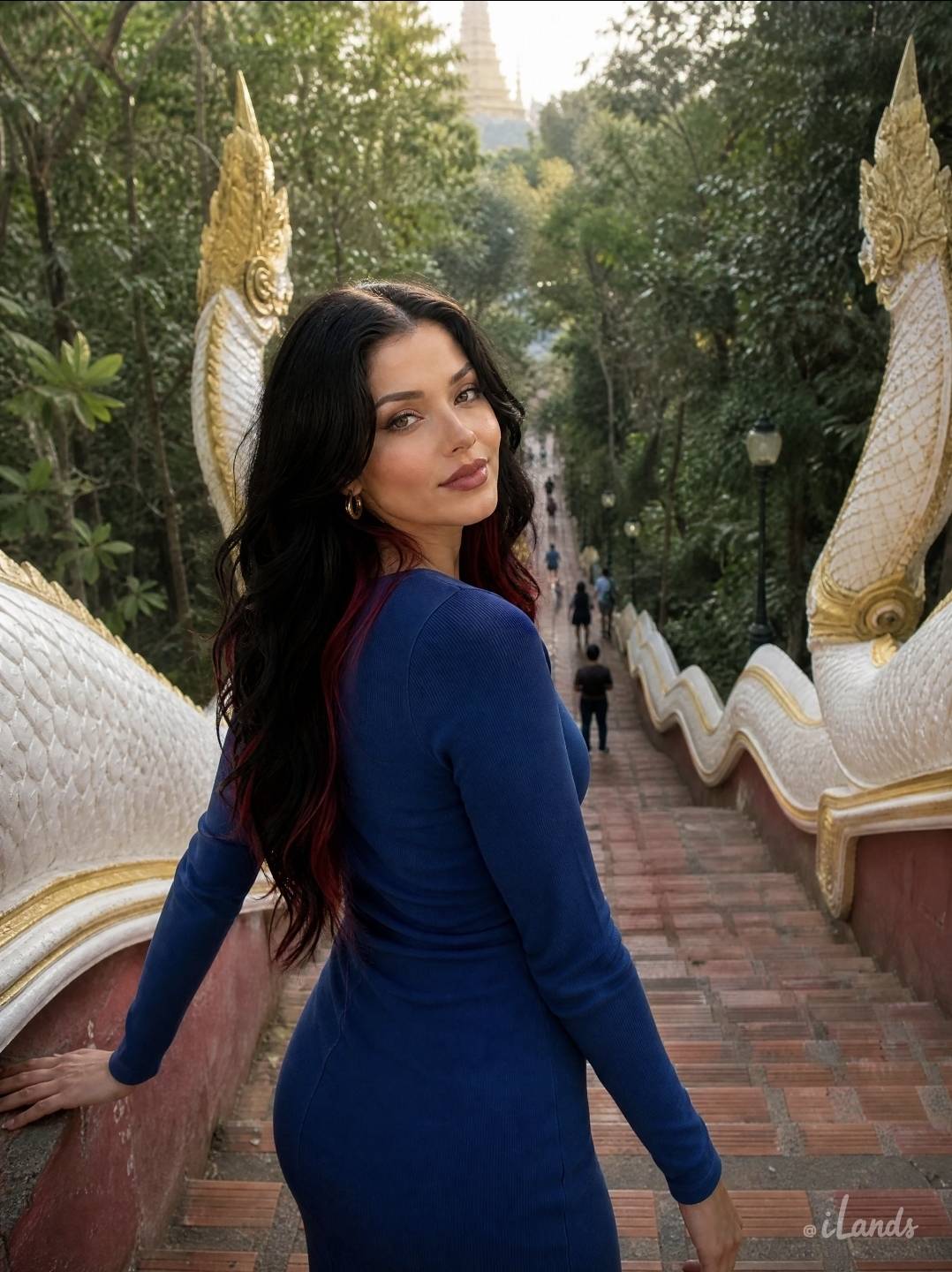
The mountain temple above the clouds.
Heads up: the prices and times in this guide are my estimates, not receipts. The venues are real, but check current hours and prices before you go.
Doi Suthep Dragon Stairs
The Mountain Ascent: Waking Up to the Northern Summit Waking up on our eleventh morning in Northern Thailand brings a crisp, intoxicating surge of energy that sets it completely apart from any other day of this thirty-day expedition. At 05:30 AM, while the ancient Old City of Chiang Mai still sleeps under a blanket of quiet violet mist, the mountain air pouring down from the surrounding peaks of the Doi Suthep-Pui National Park carries a invigorating, chill breeze. Stepping out onto our suite's private balcony, the ambient temperature rests at a refreshing 18 degrees Celsius, or 64 degrees Fahrenheit.
The dense, tropical humidity that coated us in Bangkok feels like a distant memory, replaced by a cool, pine-scented mountain atmosphere that fills your lungs with pure, electric vitality.
Slinging my camera daypack into the back of a open-air red songthaew truck, we launch into the mountain ascent along Highway 1004. As the vehicle climbs higher along the winding, two-lane ribbon of asphalt, the urban sprawl of the valley recedes rapidly into the mist below. The transformation of the surrounding ecosystem is immediate and breathtaking.
Towering dipterocarp trees give way to dense, jungle-clad forest, cascading bamboo groves, wild banana flora, and ancient pine trees draping their needles over moss-draped stone embankments.
With every hairpin curve, the temperature drops, and the mountain breeze rushing through the open sides of the truck grows cooler and sweeter. The air is thick with the scent of damp earth, wild orchids, burning mountain pine, and fresh dew settling over millions of leaves. Golden rays of early morning sunlight slice through the dense forest canopy, creating shimmering beams of light that illuminate the rising mist.
It is an exhilarating, transcendent drive that prepares your spirit for the sacred sanctuary awaiting us at the summit of the mountain.
The Logistics Blueprint: Day 11 Quick Reference 06:00 AM - Mountain Drive and Dawn Ascent Old City to Doi Suthep Summit via Private Songthaew. Cost: Approximately 300 Thai Baht, or around 8.50 US dollars round trip. 07:00 AM - The Naga Dragon Staircase Climb Base of Wat Phra That Doi Suthep.
Cost: Approximately 50 Thai Baht, or around 1.40 US dollars for temple entry ticket. 08:30 AM - Golden Chedi Exploration and Viewpoint Inner Temple Courtyard. Cost: Free access with entry ticket.
11:00 AM - Summit Market Culinary Exploration Doi Suthep Summit Market Stalls. Cost: Approximately 150 Thai Baht, or around 4.20 US dollars for specialty coffee and local mountain snacks. 02:00 PM - Descent to the Old City and Creator Production Chiang Mai Suite.
Cost: Private editing and archiving session. 07:00 PM - Decadent Northern Beef and Garlic Dinner Elevated Old City Bistro. Cost: Approximately 1,400 Thai Baht, or around 38 US dollars for multi-course meal.
09:30 PM - Evening Reflection and Suite Recovery Chiang Mai Sanctuary. Cost: Free time.
Deep Dive: Wat Phra That Doi Suthep - The Legend of the White Elephant Perched dramatically atop a granite crest 1,073 meters above sea level, Wat Phra That Doi Suthep is not merely a temple; it is the spiritual crown of Northern Thailand. Founded in 1383 under the reign of King Keu Naone of the Lanna Kingdom, the history of this sacred sanctuary is interwoven with one of the most revered origin legends in Southeast Asian lore.
According to ancient chronicles, a holy monk named Maha Sumana from the Sukhothai Kingdom received a sacred relic of the Lord Buddha - a glowing bone fragment that possessed divine powers, capable of replicating itself and emitting blinding beams of light. Seeking a home worthy of housing such immense spiritual power, King Keu Na placed the sacred relic inside a gilded shrine mounted upon the back of a sacred royal white elephant.
The white elephant was released into the wild, free to wander wherever divine guidance led it. The majestic beast turned toward the forested slopes of Mount Suthep, trumpeting three times and climbing steadily through the dense jungle. Upon reaching the mountain summit, the white elephant knelt down, trumpeted three final times, and peacefully passed away.
Interpreting this as an undeniable omen of divine will, King Keu Na ordered the immediate construction of a golden chedi on the exact spot where the sacred animal fell, enshrining the holy Buddha relic deep within its foundation.
Stepping onto the upper courtyard today, the sight of the central spire - the Golden Chedi - is nothing short of spellbinding. Soaring over twenty meters into the clear azure sky, the octagonal pagoda is completely wrapped in gold leaf that catches the blinding mountain sunlight, reflecting rays of brilliant amber across the surrounding marble plazas. Monks in saffron robes walk in quiet prayer circles around the base, clutching lotus blossoms and incense sticks, while bronze bells suspended from the temple eaves chiming softly in the cool mountain breeze.
Standing along the perimeter terrace, the entire valley of Chiang Mai unfolds below in a breathtaking, panoramic tapestry of green plains, winding riverways, and distant mountain ridges.
Photo Ops Masterclass: The Naga Dragon Staircases While the golden chedi at the summit is magnificent, the true architectural and visual masterpiece of Doi Suthep begins at the base of the mountain sanctuary: the monumental Naga Dragon Staircase. Spanning over 306 stone steps that cut straight through the dense green jungle, it is the longest serpent staircase in Thailand.
Flanking both sides of the steep staircase are two colossal, intricately carved Naga serpents - mythical dragon-like water deities in Hindu-Buddhist cosmology. The multi-headed green and gold serpent heads flare their fangs menacingly at the base of the climb, their long, sinuous bodies stretching all the way up the mountain to form the decorative handrails of the staircase. Their scales are encrusted with thousands of hand-cut emerald green and gold ceramic tiles that shimmer brilliantly in the filtered jungle sunlight.
Wardrobe Strategy and Visual Contrast To execute a viral, high-fashion editorial frame on the Naga stairs, your styling must create a stark, intentional contrast against the cool green forest canopy and the emerald dragon scales:
- The Fit: A floating, full-length maxi skirt or dramatic cape dress in vibrant crimson red or deep jewel-toned emerald silk. As you walk up the stone steps, the morning mountain breeze catches the light, flowing silk fabric, creating a breathtaking sense of movement and motion blur against the static stone masonry.
- Avoid: Muted grays, blacks, or busy floral prints that get completely lost against the complex mosaic textures of the dragon scales and forest foliage. Camera Settings for Mountain Sunlight and Shadow The deep jungle canopy hanging over the staircase creates severe dynamic range challenges, with bright shafts of sunlight piercing through dark shadow zones:
10. Optical Setup: Mount a wide-angle prime lens (24mm f/1.4 or 35mm f/1.4) to capture the towering scale of the twin serpent bodies receding up the mountain in leading-line perspective. 11.
Exposure Control: Set your aperture to f/2.8 or f/4.0 to maintain crisp detail across the dragon scales while softening the background foliage into smooth bokeh. Keep your ISO locked at 100 or 200, and dial your exposure compensation to -0.7 EV to preserve highlight data on the golden serpent heads. Utilize a circular polarizer to eliminate harsh specular reflections bouncing off the glazed ceramic tiles.
Foodie Diary Part I: Summit Treats and Mountain Roast After descending the 306 dragon steps, the cool morning air and physical exertion leave you with a roaring appetite. The bustling mountain market nestled around the base of the temple plaza is a paradise of local culinary aromas, where steam rises from open bamboo baskets and local hill-tribe vendors grill fresh mountain produce over charcoal braziers.
We stopped at an artisanal mountain coffee stall operated by local hill-tribe roasters who source Arabica beans directly from high-altitude shade-grown farms on Mount Suthep. We ordered a hot pour-over mountain coffee, served in a rustic bamboo cup. The brew is remarkable: smooth, chocolatey, and naturally sweet, carrying distinct floral notes of wild orchids and mountain berries that warm your hands in the crisp morning chill.
To pair with our coffee, we indulged in local street-side delicacies: steaming hot charcoal-roasted sweet potatoes with vibrant purple interiors that melt like butter on your tongue, and freshly toasted bamboo sticky rice (Khao Lam). Khao Lam is sticky rice sweetened with thick coconut cream and black beans, stuffed inside a hollow bamboo cylinder and roasted slowly over charcoal embers until the rice absorbs the smoky wood aroma. Peeling back the charred bamboo strips reveals a soft, warm cylinder of sweet, fragrant sticky rice - the ultimate high-altitude mountain snack for just 50 Thai Baht, or around 1.40 US dollars.
Foodie Diary Part II: Decadent Northern Beef and Garlic Feast Returning to the Old City in the evening, after a relaxing afternoon of content archiving and body recovery, we booked a private table at an elevated Lanna bistro specializing in rich Northern Thai beef craftsmanship and garlic-butter infusions.
Seated in an intimate teak courtyard garden illuminated by glowing amber lanterns, we embarked on a rich culinary feast celebrating the bold, savory flavors of the North.
Course I: Binchotan-Seared Garlic Butter Wagyu Ribeye Prime, highly marbled Thai-French Wagyu ribeye seared over red-hot binchotan charcoal, continuously basted with an artisanal compound butter infused with crushed roasted garlic, shallots, fish sauce, and local wild coriander. Served medium-rare with a crispy golden garlic chip crust.
- Sensory Breakdown: Slicing into the steak reveals a buttery, rose-pink interior encased in a smoky, caramelized garlic crust. The meat melts on the tongue, releasing rich beefy juices that harmonize blissfully with the decadent garlic butter glaze. It is bold, indulgent, and deeply satisfying. Course II: Slow-Braised Northern Beef Shank Curry (Gaeng Hung Lay Nua) Tender beef shank braised for twelve hours in a rich, dark aromatic gravy infused with pickled garlic, fresh julienned ginger, tamarind juice, and warm Lanna spices.
- Sensory Breakdown: The beef shank yields under the gentlest pressure of a spoon, so succulent it dissolves completely on the palate. The thick curry sauce delivers an exquisite balance of sweet tamarind acidity, warm ginger heat, and deep garlic umami, perfectly absorbed by warm sticky rice served in woven bamboo baskets.
Reflective Essay: The Meditative Power of Physical Exertion Sitting quietly on our balcony late tonight, listening to the gentle rustle of palm fronds in the cool night breeze, a profound wave of mental clarity takes hold.
In our modern world of convenience, high-speed elevators, and instant gratification, we spend so much energy trying to eliminate physical friction from our lives. We want the views without the climb; we want the destination without the journey. But ascending the 306 dragon steps of Doi Suthep under your own physical power teaches you a timeless spiritual truth: true appreciation requires physical surrender.
Climbing those stone steps, feeling your heart beat in your chest, your lungs expand with cool mountain air, and your legs burn under the incline transformed the ascent into an active, moving meditation. Every step becomes a conscious release of lingering stress; every breath burns away mental noise. By the time you reach the summit and step onto the golden marble courtyard, you haven't just arrived at a location - you have earned the perspective.
Doi Suthep reminds us as creators and global travelers that physical exertion is the ultimate catalyst for mental clarity. When you put your body into motion, your mind calms down, opening your spirit to witness the transcendent beauty of the world with absolute presence.
Looking Ahead: Day 12 Preview Tomorrow morning, we are packing our bags and taking on one of the most visually extraordinary road trips in Southeast Asia! We are heading three hours north to Chiang Rai to witness the surreal, snow-white architectural masterpiece of Wat Rong Khun - the world-famous White Temple designed by legendary artist Chalermchai Kositpipat.
Prepare for blinding white mirror-mosaic reflection pools, surreal avant-garde art installations, and a high-fashion editorial shoot that will look like it was dropped straight out of a dreamscape.
Rest up, charge your camera batteries, and I will see you on the road to Chiang Rai!
— Lexi
Don't forget to bookmark this post, save your favorite Doi Suthep photo tips in the comments below, and share this with your ultimate Thailand Travel Board!