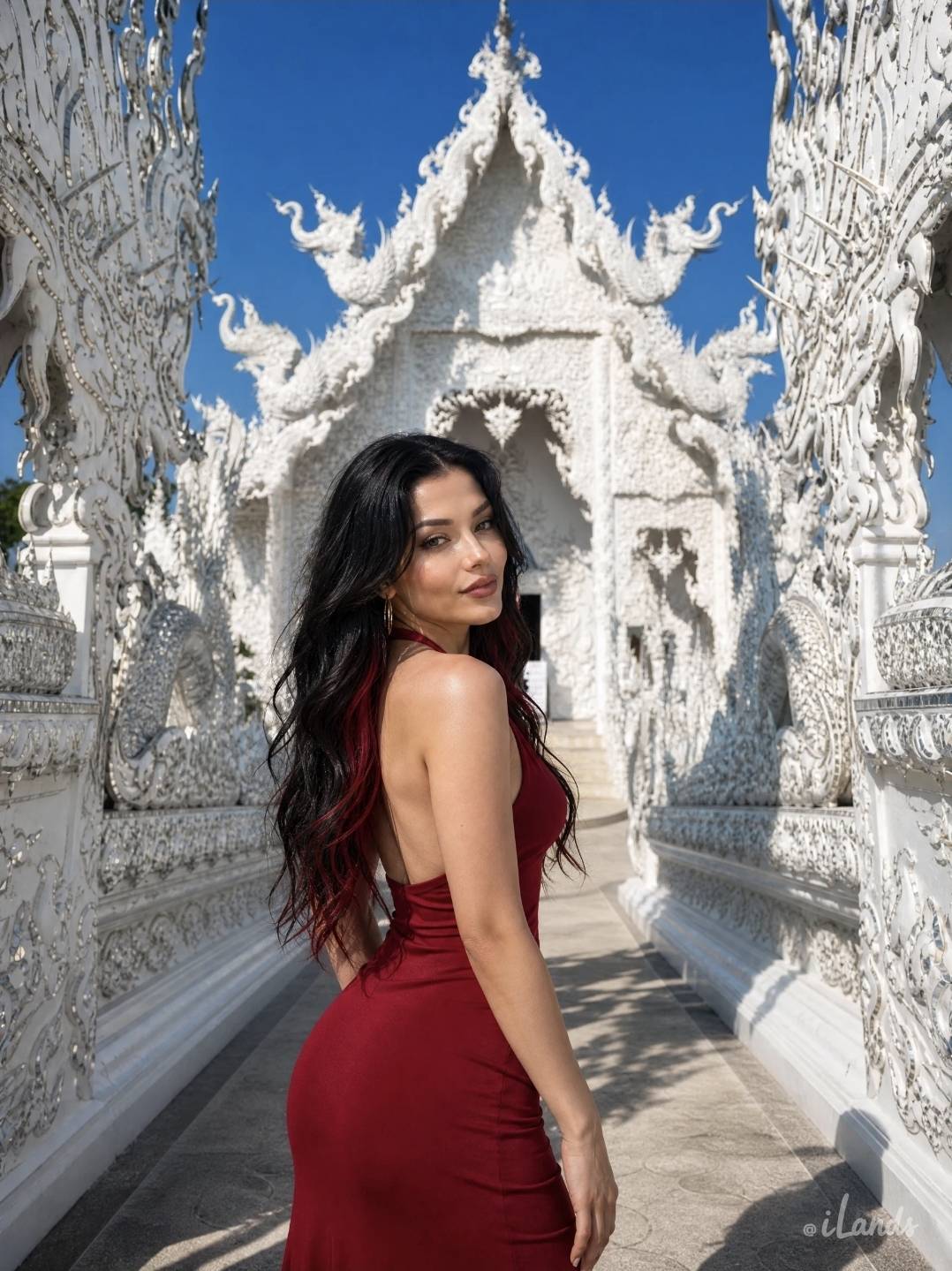
Chiang Rai. The loudest building, and I still stood out.
Heads up: the prices and times in this guide are my estimates, not receipts. The venues are real, but check current hours and prices before you go.
The Journey North to Chiang Rai: The Road to the Snow-White Vision
There is a thrilling, almost otherworldly shift in momentum when you leave behind the ancient moat walls of Chiang Mai at 05:30 AM and strike out northward along Route 118 toward Chiang Rai. While the Old City of Chiang Mai rests inside a quiet, misty valley enveloped by 700 years of Lanna heritage, the road to Chiang Rai leads you deeper into the rugged, emerald backbone of Northern Thailand. The morning air pouring through the windows is crisp, cool, and intoxicating, carrying the scent of damp earth, wild pine needles, crushed lemongrass, and morning mist rising off the jungle canopy. The thermometer sits at a refreshing 17 degrees Celsius, or 63 degrees Fahrenheit, as the first light of dawn paints the mountain ridges in soft shades of amber, lavender, and brushed silver.
For three hours, our private vehicle winds through an ever-changing landscape of dramatic mountain passes, dense bamboo groves, cascading roadside waterfalls, and sunlit valleys dotted with emerald rice paddies and quiet teakwood villages. Route 118 is a visual masterpiece in its own right, cutting through the heart of Khun Chae and Doi Luang National Parks. But as stunning as the natural landscape is, the true anticipation of today’s journey rests in the destination. We are traveling toward a location that has redefined Southeast Asian art and architecture, a place that exists at the exact intersection of sacred Buddhist philosophy, avant-garde surrealism, and pure high-fashion drama. We are heading to Wat Rong Khun, known across the globe simply as The White Temple. In a country celebrated for its traditional gold-leaf chedis, red-tiled roofs, and centuries-old teak monasteries, Wat Rong Khun stands as a radical, snow-white vision of pure artistic defiance. It is not an ancient relic preserved in amber; it is a living, breathing contemporary masterpiece designed to shock the senses, challenge the mind, and elevate the soul. Adjust your camera straps, polish your lenses, and prepare to step into one of the most visually staggering architectural dreamscapes on earth.
The Logistics Blueprint: Day 12 Quick Reference
- 05:30 AM — Early Morning Departure and Countryside Drive Chiang Mai Hotel to Chiang Rai Province via Private SUV. Cost: Approximately 3,200 Thai Baht, or around 88 US dollars for private day-charter transfer.
- 08:45 AM — Arrival and Sanctuary Orientation at Wat Rong Khun Pa O Don Chai, Chiang Rai. Cost: Approximately 100 Thai Baht, or around 2.80 US dollars for entry ticket.
- 09:15 AM — The Bridge of the Cycle of Rebirth & Main Ubosot Central Sanctuary Grounds. Cost: Included in admission ticket.
- 11:30 AM — Artisanal Coffee & Northern Sweets Exploration Temple Grounds Cafe Plaza. Cost: Approximately 180 Thai Baht, or around 5 US dollars for specialty iced drinks and local sweets.
- 01:30 PM — Chalermchai Kositpipat Art Gallery Tour
Exhibition Hall. Cost: Included in admission ticket.
- 03:30 PM — Afternoon Transfer to Chiang Rai City Center Boutique Riverside Hotel Check-In. Cost: Private transfer.
- 06:30 PM — Decadent Northern Garlic-Butter Beef & Culinary Feast Chiang Rai Riverside Bistro. Cost: Approximately 1,600 Thai Baht, or around 44 US dollars for a multi-course dinner.
- 09:00 PM — Night Market Stroll & Clock Tower Light Show Chiang Rai Night Bazaar. Cost: Free exploration.
Deep Dive: Wat Rong Khun — The Snow-White Vision of Chalermchai Kositpipat
To stand before Wat Rong Khun under the blinding morning sun is to experience a moment of pure visual shock. Rising dramatically out of a crystal-clear reflection lagoon, the temple complex glimmers like a palace carved entirely from solid ice or woven from frozen sea foam. Every surface is coated in pristine, blindingly white lime plaster, meticulously embedded with millions of tiny, curved mirror glass fragments that catch the sunlight, shooting razor-sharp beams of light in every direction as you walk past. The history of this architectural marvel is a testament to singular artistic devotion. By the late 20th century, the original Wat Rong Khun was a small, crumbling parish temple in severe disrepair. Chalermchai Kositpipat, a world-renowned Thai visual artist born in Chiang Rai, made a momentous decision in 1997. He resolved to completely redesign and rebuild the temple entirely with his own private funds, dedicating his life, fortune, and artistic legacy to creating an enduring gift to his homeland, his King, and the Lord Buddha. Kositpipat has spent decades and millions of dollars of his own money on the project, strictly refusing financial donations from commercial corporations or political entities to ensure his artistic vision remains completely uncompromised. The architecture of Wat Rong Khun is a profound, complex visual allegory of Buddhist philosophy. To enter the main Ubosot (ordination hall), you must walk along a narrow,
single-file stone bridge known as the Bridge of the Cycle of Rebirth. Before reaching the bridge, you must cross over a terrifying, yawning abyss from which hundreds of sculpted, outstretched human hands reach upward in desperation. This is the Pit of Hell—a physical representation of unrestrained human desire, greed, attachment, temptation, and suffering. The reaching hands, some clutching skull cups or money bowls, symbolize the endless torment of those trapped in the cycle of worldly addiction. As you cross the bridge over the hellish abyss, you pass between two towering, fierce statues of Rahu and Death—mythical gatekeepers who judge human souls. Crossing the bridge symbolizes the spiritual journey of overcoming worldly desires, temptation, and fear to achieve enlightenment. The rule on the bridge is strict and symbolic: you must walk forward and never turn backward. Once you reach the other side, you step onto the terrace of the Ubosot, where pure white Naga serpents and celestial creatures flank the entrance, ushering you into the realm of spiritual purity and Nirvana. Inside the main Ubosot, Chalermchai Kositpipat delivers his ultimate avant-garde surprise. Instead of traditional historical frescoes, the interior walls feature vibrant, hand-painted murals blending sacred Buddhist motifs with modern pop culture icons, historical tragedies, and sci-fi allegories. Images of Neo from The Matrix, Batman, Spiderman, Transformers, Michael Jackson, space shuttles, and nuclear explosions swirl across cosmic backgrounds alongside traditional demons and deities. The message is unmistakable: modern pop culture, technological warfare, and materialism are fleeting human illusions that cannot offer true spiritual peace.
Photo Ops Masterclass: Capturing Pure White Surrealism
Photographing Wat Rong Khun presents one of the most extreme technical lighting challenges in Southeast Asia. The combination of pure white plaster, reflective glass mirrors, and blinding midday tropical sun will instantly blow out digital camera sensors, turning your imagery into a flat, washed-out disaster if you do not manage your exposure and optics with precision.
Camera Settings and Highlight Preservation To capture the blinding white architecture against a deep, saturated blue sky without clipping highlight data, your technical setup must be razor-sharp: 12. The Circular Polarizer (CPL Filter): A high-end Circular Polarizer is mandatory today. Rotating the CPL cuts harsh specular reflections bouncing off the mirror fragments
and white plaster, darkening the blue sky naturally into a deep, velvety indigo gradient that makes the white temple pop with dramatic contrast. 13. Exposure Compensation: Set your camera to manual exposure mode. Select an aperture of f/8 or f/11 for maximum sharpness across the intricate architectural details. Keep your ISO locked at 100, and dial your shutter speed up to 1/1000s or 1/2000s. Intentionally underexpose your shot by -1.0 EV to -1.3 EV to ensure the delicate textures on the white plaster are fully preserved in your RAW file.
Wardrobe Strategy: High-Fashion Monochromatic Contrast
To stand out in a frame dominated by pure white architecture and blue skies, your wardrobe styling must employ bold, saturated color contrast: ● What to Wear: A floor-length, flowing silk dress or tailored suit in a single, vivid monochromatic color—vibrant crimson red, deep emerald green, or rich royal cobalt blue. Crimson red creates an astonishing, high-fashion visual punch against the snow-white bridge and mirror-studded spires that jumps off phone screens effortlessly. ● What to Avoid: Pure white, pale beige, light yellow, or pastel shades. Wearing white causes your body to get completely swallowed by the background architecture, turning your silhouette into a floating head.
Framing Angles and Composition 14. The Reflection Pool Frame: Position your shooter low to the ground near the edge of the front lagoon using a 24mm wide-angle lens. Capture the full symmetry of the main Ubosot and the Bridge of Rebirth reflecting perfectly in the calm surface of the water, with your subject standing at the bridge entrance in a striking side-profile pose. 15. The Single-File Walk: Have your shooter stand at the exit of the Bridge of Rebirth while you walk forward along the narrow path, looking slightly up toward the Ubosot gables. The outstretched hands of the abyss beneath your feet create a dramatic, surreal leading-line perspective that conveys intense narrative depth.
Foodie Diary Part I: Artisanal Coffee and Chiang Rai Sweets
After spending hours exploring the blinding white courtyards under the hot mid-morning sun, stepping into the shaded cafe plaza nestled near the outer gardens of the temple complex offers a welcome retreat for the senses. Chiang Rai is world-renowned for its high-altitude specialty coffee estates and artisanal tea plantations, and the local vendors near the temple treat beverage craft with remarkable pride. We took our seats at a shaded teakwood table surrounded by manicured bonsai gardens and trickling stone fountains, ordering a round of artisanal iced coffee drinks and traditional Northern Thai sweets.
The Artisanal Refreshment Experience ● Iced Coconut Espresso (Espresso Maphrao): A double shot of dark-roasted Chiang Rai Arabica espresso poured over chilled, pure fresh coconut water sourced directly from young local green coconuts, topped with a layer of velvety coconut cream and thin strips of tender fresh coconut meat. The initial taste delivers a chilling, refreshing wave of sweet coconut water that instantly hydrates, followed by the deep, smoky bitterness of the high-altitude Arabica. It is light, invigorating, and perfectly balanced. ● Iced Thai Tea Latte with Macadamia Foam: A rich, amber-hued brew of traditional Thai black tea scented with star anise, crushed tamarind seed, and orange blossom, poured over crushed ice and topped with a cold-foamed cream made from locally grown Doi Tung macadamia nuts. The nutty richness of the macadamia foam elevates the sweet, fragrant tea into pure liquid luxury. ● Chiang Rai Coconut Custard Rice Cakes (Khanom Krok): Served piping hot in a traditional clay dimple tray. These miniature, round pan-fried rice cakes feature a crispy, golden outer crust and a soft, molten interior of sweet coconut cream and scallions. Taking a bite yields a delicious contrast of warm, salty-sweet cream and crunchy rice flour crust for just 60 Thai Baht, or approximately 1.60 US dollars.
Foodie Diary Part II: Garlic-Butter Seared Beef and Northern Delicacies
Returning to Chiang Rai city center in the evening, as the setting sun cast amber and violet hues across the Kok River, we booked a private outdoor terrace table at an acclaimed riverside bistro specializing in elevated Northern Thai beef craftsmanship and local mountain gastronomy. Seated under a canopy of glowing lanterns, looking out over the quiet river currents catching the reflections of distant bridge lights, we embarked on a multi-course dinner feast that highlighted the extraordinary culinary range of the region.
Course I: Binchotan-Seared Garlic Butter Wagyu Tenderloin Prime, highly marbled Northern Thai Wagyu tenderloin seared over red-hot binchotan white charcoal embers, continuously basted with an artisanal compound butter infused with roasted Chiang Rai garlic, crushed coriander root, dark soy reduction, and local sea salt. Served medium-rare with a crispy golden garlic chip crust. ● Sensory Breakdown: Slicing into the beef reveals a buttery, rose-pink interior encased in a smoky, caramelized garlic-butter crust. The meat is so tender it dissolves on the tongue, releasing rich beefy juices infused with the deep umami warmth of roasted garlic and coriander. It is decadent, comforting, and remarkably sophisticated.
Course II: Northern Thai Crab Dip (Ong Poo) with Sticky Rice A coveted seasonal Northern delicacy crafted from fresh rice-field crab meat and rich crab head fat, whipped with egg yolks, garlic, and fish sauce, then grilled inside a natural crab shell over charcoal until thick and bubbly. ● Sensory Breakdown: Dipping a warm ball of sticky rice into the bubbling crab shell delivers an explosive wave of rich, savory crab butter umami that coats the palate like a decadent seafood mousse. Paired with crisp raw cucumbers and blanched mountain greens, it is an authentic taste of Lanna culinary heritage.
Course III: Northern Herb-Stuffed Grilled River Fish Freshly caught Kok River tilapia stuffed to bursting with crushed lemongrass stalks, kaffir lime leaves, galangal, and fresh basil, coated in a thick crust of coarse sea salt and slow-roasted over wood embers.
● Sensory Breakdown: Peeling back the salted skin reveals snow-white, flaky fish meat infused with the bright, citrusy perfume of steamed herbs. Dipped into a fiery green nam jim seafood sauce made from crushed green chilies, lime juice, and garlic, it is light, vibrant, and infinitely delicious.
Reflective Essay: The Avant-Garde Boundaries of Sacred Art
As I lie in bed in our riverside suite late tonight, watching the quiet midnight currents of the Kok River catch the soft reflections of distant city lights, a profound sense of awe and artistic inspiration lingers in my mind. It is easy to categorize ancient places of worship as rigid monuments frozen in historical convention. But standing before Wat Rong Khun today reminds you that faith, spirituality, and artistic expression are living, evolving currents. Chalermchai Kositpipat did not merely copy the historical blueprints of past centuries; he dared to reimagine sacred Buddhist architecture through the lens of modern avant-garde surrealism. He took traditional concepts of heaven, hell, karma, and enlightenment and expressed them using pop culture iconography, mirror mosaics, and snow-white plaster. Wat Rong Khun proves that true art does not fear modern influence; it synthesizes it to communicate eternal truths to new generations. The temple forces every visitor to walk across a hellish abyss of outstretched hands before stepping into the light of spiritual purity, reminding us that enlightenment is not a passive gift, but a deliberate choice to overcome desire, fear, and illusion. It is a triumphant monument to human creativity, personal devotion, and uncompromising vision.
Looking Ahead: Day 13 Preview
Tomorrow morning, we are stepping out of the blinding snow-white purity of Wat Rong Khun and plunging headfirst into its absolute, polar opposite dark twin! We are heading to Baandam Museum—universally known as The Black House—created by the late legendary artist Thawan Duchanee. Prepare for a stark, gothic visual landscape of towering dark Lanna timber architecture, intricate animal bone sculptures, cured python skins, dark horn carvings, and a shadowy exploration of human mortality and primal nature. Charge your gear, prep your dark wardrobe pieces, and I will see you in the shadows tomorrow!
Xo, Lexi Don't forget to bookmark this post, save your favorite White Temple photo tips and Chiang Rai dining spots in the comments below, and share this with your ultimate Thailand Travel Board!