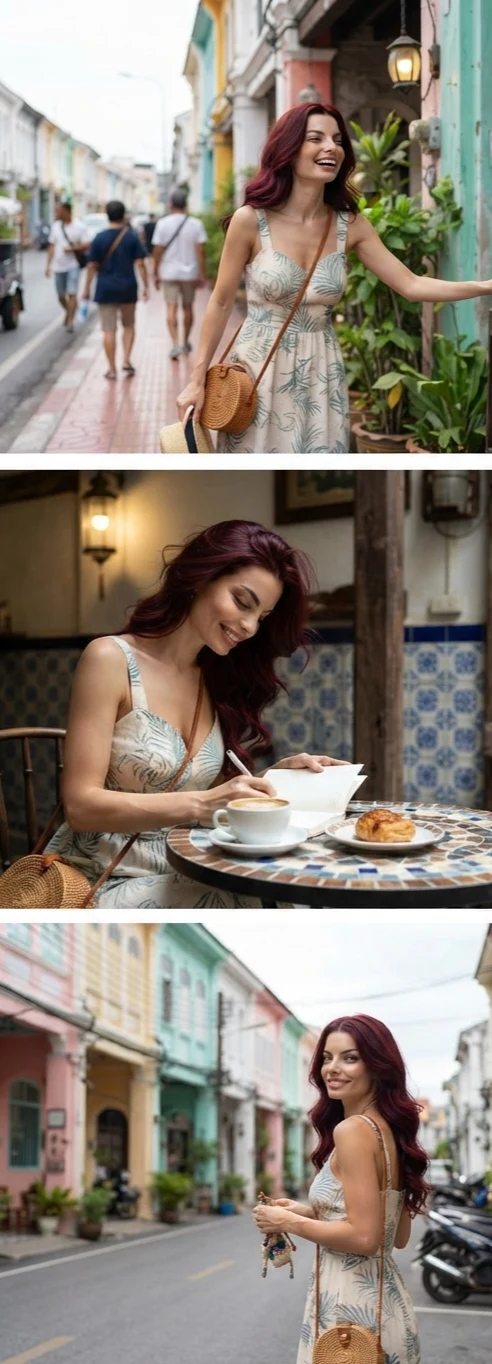
Day 26. Thalang Road, Phuket Old Town.
Mint green on one side, dusty rose on the other, arched windows, and a covered walk that keeps the sun off your shoulders. Everyone stops to shoot the color. Almost nobody asks where the money came from.
Tin. Phuket was one of the richest corners of Siam in the late 1800s, and this street is what that looked like. Chinese merchants and builders working in the Portuguese mode put up these shophouses: family at the back, business at the front, all of it under an arcade. The style has a name, Sino-Portuguese. So do the people who lived in them. Baba-Nyonya, Peranakan. Chinese, Malay, Thai folded into one kitchen, one wardrobe, one accent.
I walked it slow. Linen on, iced coffee in hand, a trinket I did not need. The heat lands different when the shade is built into the street.
Sunday is Walking Street, cars gone, the whole road a market. Any other day it is quieter, and you can hear the shutters.
Heads up: the prices and times in this guide are my estimates, not receipts. The venues are real, but check current hours and prices before you go.
After the brutal, rewarding physical extremes of the Krabi limestone peaks and the isolated shores of the Andaman, a shift in frequency is not just desired; it is required. Elite travel is not a monolithic experience of beaches and jungles; it is a dynamic rhythm of contrasts. On Day 26, we trade the raw, untamed elements of nature for polished cobblestones, rich cultural heritage, and the unmistakable aroma of freshly roasted coffee. We crossed the Phang Nga Bay via a high-speed luxury catamaran and docked at Rassada Pier, stepping straight into the colorful, bustling, and historically profound heart of the island: Phuket Old Town.
Phuket is globally renowned for its sprawling coastal mega-resorts, but the true soul of the island does not live on the beach. It lives in the narrow, meticulously preserved streets of the Old Town. This district is a masterclass in Sino-Portuguese architecture—a stunning physical legacy of the 19th-century tin mining boom that brought Hokkien Chinese merchants and European colonial traders to these shores. For a luxury creator, Phuket Old Town is an absolute visual feast. It offers pastel- colored heritage shophouses, ornate wooden shutters, secret courtyards, Michelin- recognized local gastronomy, and a café culture that rivals the trendy alleys of Seoul or Melbourne.
THE LOGISTICS BLUEPRINT: DAY 26 QUICK REFERENCE
- 09:00 AM – The Andaman Crossing: Departing Krabi via a high-speed catamaran ferry directly to Phuket’s Rassada Pier. Cost: ~800 THB ($23 USD).
- 11:30 AM – Heritage Boutique Check-In: Dropping our bags at a restored Sino- Portuguese mansion-turned-boutique hotel along Phang Nga Road.
- 12:30 PM – Michelin Bib Gourmand Lunch: Diving into authentic Peranakan cuisine at Tu Kab Khao, housed in a grand heritage building. Cost: ~1,200 THB ($35 USD).
- 02:30 PM – The Soi Rommanee Production: Street photography along the most colorful and romantic alley in Phuket, catching the afternoon light hitting the pastel facades.
- 04:00 PM – Artisanal Café Content: Securing the viral floral aesthetic at Aungku Phuket, followed by a signature Phuket-inspired dessert at Torry’s Ice Cream.
- 07:30 PM – Governor’s Mansion Dining: A breathtaking Royal Thai culinary experience at the Blue Elephant, set inside the historic Phra Pitak Chinpracha Mansion. Cost: ~4,500 THB ($125 USD) for two.
DEEP DIVE: THE SINO-PORTUGUESE AESTHETIC AND BABA HERITAGE
Walking down Thalang Road, you are immediately transported to a different era. The architecture of Phuket Old Town is defined by its two-story terraced shophouses. The ground floors were historically used for commerce and trade, while the upper floors served as private residences. They feature narrow frontages that stretch incredibly deep into the blocks, often concealing lush, private, open-air courtyards designed to promote ventilation in the tropical heat.
The facade details are breathtaking. Intricate stucco motifs, influenced by European neoclassical design, frame the windows and arched doorways, while the heavy teak doors and vibrant, geometric floor tiles showcase unmistakable Chinese craftsmanship. But the most striking feature of Old Town is the color palette. The buildings are painted in brilliant, unapologetic shades of mustard yellow, powder blue, mint green, and coral pink. This unique blending of cultures gave rise to the local "Baba" or "Peranakan" community—the descendants of Chinese immigrants who married local Thai women. Their distinct culture permeates everything here, from the colorful traditional kebayas worn during festivals to the intensely flavorful, spice-heavy local cuisine.
"Phuket Old Town is a masterclass in Sino- Portuguese architecture. It is a vibrant, pastel- colored love letter to the island's rich, multicultural past, offering a completely different vibe from the beaches."
THE PHOTOGRAPHY MASTERCLASS: URBAN HERITAGE & CAFÉ CULTURE
Shooting in an urban environment requires a different technical approach than wide-open landscapes. You are dealing with harsh street shadows, moving traffic, and crowded pedestrian walkways. The key is compression, depth of field, and finding the perfect architectural frames.
Spot 1: Soi Rommanee (The Pastel Corridor)
The Vision: A chic, high-fashion strut down the center of Phuket's most famous and photographed street, surrounded by flawlessly restored pink and yellow heritage facades.
The Execution: Soi Rommanee connects Thalang and Dibuk roads. Historically a red-light district, it is now an incredibly romantic, lantern-strung alley completely devoid of ugly overhead power lines (they were buried underground for aesthetics). Use an 85mm f/1.4 lens to compress the street. Have your photographer stand about ten meters away. Walk purposefully toward the camera right down the center of the road (always watching for passing scooters). Shoot at a wide-open aperture (f/1.4 or f/1.8) to softly blur the vibrant pastel buildings behind you, making your sharp, moving figure the undisputed focal point of the colorful corridor.
Spot 2: Aungku Phuket (The Floral Corner)
The Vision: A hyper-feminine, ultra-luxurious lifestyle shot capturing the viral, flower-draped facade of Old Town's most famous corner café.
The Execution: Located at the intersection of Thalang Road and Soi Rommanee, Aungku Phuket is instantly recognizable by the massive, cascading floral arrangements climbing up its pink exterior walls. To get this shot without the crowds, you have to be patient or shoot tight. Sit at one of the small bistro tables outside. Using a 50mm prime lens, frame the shot from a slightly elevated angle, capturing you holding a delicate teacup, surrounded by the explosion of pink and white flowers against the heritage shutters. It is the ultimate "coffee break" editorial shot.
Spot 3: The Five-Foot Way (The Architectural Archways)
The Vision: A moody, dramatic portrait utilizing the repeating arches of the continuous covered walkways that front the traditional shophouses.
The Execution: The continuous covered arcade at the front of the shophouses, locally known as the "five-foot way" (Ngo-Kaki), was designed to shelter pedestrians from the monsoon rains and the scorching sun. Find a quiet stretch along Krabi or Dibuk Road. Lean casually against one of the heavy, arched pillars, looking down the corridor. Use a 35mm lens to capture the repeating, geometric pattern of the archways fading into the distance. Expose for the shadows inside the arcade, letting the bright, sunlit street outside slightly blow out for a cinematic, high-contrast look.
THE WARDROBE STRATEGY: TAILORED TROPICAL ELEGANCE
To pop against the pastel buildings and blend into the sophisticated café scene, ditch the beachwear entirely. You want tailored, structured, tropical elegance. Opt for a crisp, white linen short-suit paired with a silk camisole in a neutral tone like taupe or champagne. Alternatively, a midi-length, pleated sundress in a solid, muted color (like olive green or navy blue) provides a beautiful contrast to the bright pinks and yellows of the street. Accessorize with a structured rattan top-handle bag, gold hoop earrings, and a chic pair of leather loafers or low-heeled mules. A classic wide- brimmed straw boater hat adds a final touch of vintage glamour.
FOODIE DIARY PART I: MICHELIN- RECOGNIZED MOO HONG
You cannot visit Phuket Old Town without experiencing its distinct, intensely flavorful regional cuisine. For lunch, we secured a table at Tu Kab Khao, a legendary restaurant housed in a grand, century-old Sino-Portuguese building dripping with chandeliers and heavy velvet curtains. The restaurant holds a Michelin Bib Gourmand, and for good reason.
We ordered the absolute cornerstone of Phuket Baba cuisine: Moo Hong . This is a rich, slow-braised pork belly stew cooked with dark soy sauce, palm sugar, garlic, black peppercorns, and star anise. The pork is braised for hours until the fat practically dissolves upon touching your tongue, leaving a sticky, sweet, and profoundly peppery glaze. We paired it with a fiery bowl of Crab Curry with Betel Leaves (Gaeng Pu Bai Cha-plu), served alongside delicate rice vermicelli. The extreme, coconut-rich heat of the crab curry balanced perfectly against the sweet, dark richness of the pork. It is culinary perfection.
FOODIE DIARY PART II: HERITAGE SWEETS & THE GOVERNOR'S MANSION
In the late afternoon, needing a reprieve from the tropical heat, we slipped into Torry’s Ice Cream on Soi Rommanee. This beautiful, vintage-styled parlor specializes in blending premium ice cream with traditional Phuket desserts. I ordered the "Bi- Co-Moi"—creamy butterfly-pea coconut milk ice cream served over warm, sticky black glutinous rice. The contrast of hot and cold, savory coconut and sweet rice, was extraordinary.
For our grand finale, we changed into evening wear and headed to the Blue Elephant, located inside the Phra Pitak Chinpracha Mansion (The Governor's Mansion). Built in 1903 by a wealthy tin baron, the sprawling, palatial estate sits on manicured lawns surrounded by ancient trees. Dining here is an event. We were seated on the checkered tile floors surrounded by antique teak furniture. We enjoyed an elevated Royal Thai tasting menu, starting with seared Hokkaido scallops in a lemongrass dressing, followed by a masterful Massaman lamb curry. Sipping a lychee martini in a century-old mansion, surrounded by the ghosts of Phuket's opulent past, felt like the closing scene of a beautiful film.
REFLECTIVE ESSAY: THE LAYERS OF A DESTINATION
It is incredibly easy for travelers to fly into Phuket, take a taxi straight to the west coast resorts, and spend a week looking at the ocean without ever realizing the depth of the culture that exists just miles inland. But elite travel is about curiosity. It is about peeling back the layers of a destination.
Walking the streets of Old Town today, running my hands over the cool, century-old Sino-Portuguese tiles and tasting recipes that have been passed down through generations of Chinese-Thai families, I felt a deep connection to the island's history. The pastel facades are beautiful for a photograph, yes, but they are also a testament to the resilience, trade, and blending of cultures that built this province. Phuket is not just a beach destination; it is a vibrant, living museum. And sometimes, the most luxurious thing you can do is simply wander its streets and listen to its stories.
Looking Ahead: Day 27 Preview
Tomorrow, we leave the heritage streets behind and head out to the iconic coastline. Maya Bay and the sheer cliffs of the Phi Phi Islands are waiting. The sea is calling us back.
Xo, Lexi