Day 27: Maya Bay.
This is the beach from The Beach. Leo jumped off a cliff here in 2000 and the world followed. At the peak, thousands of people a day stood on 250 meters of sand, boats dropped anchors straight onto the coral, and the bay started dying.
Thailand did the unthinkable: it closed. June 2018, shut to everyone. It stayed shut three and a half years. They replanted coral, let the sand rebuild, and reopened on January 1, 2022 with rules. A daily cap, timed slots, and no boats inside the bay anymore. You dock at the back and walk in.
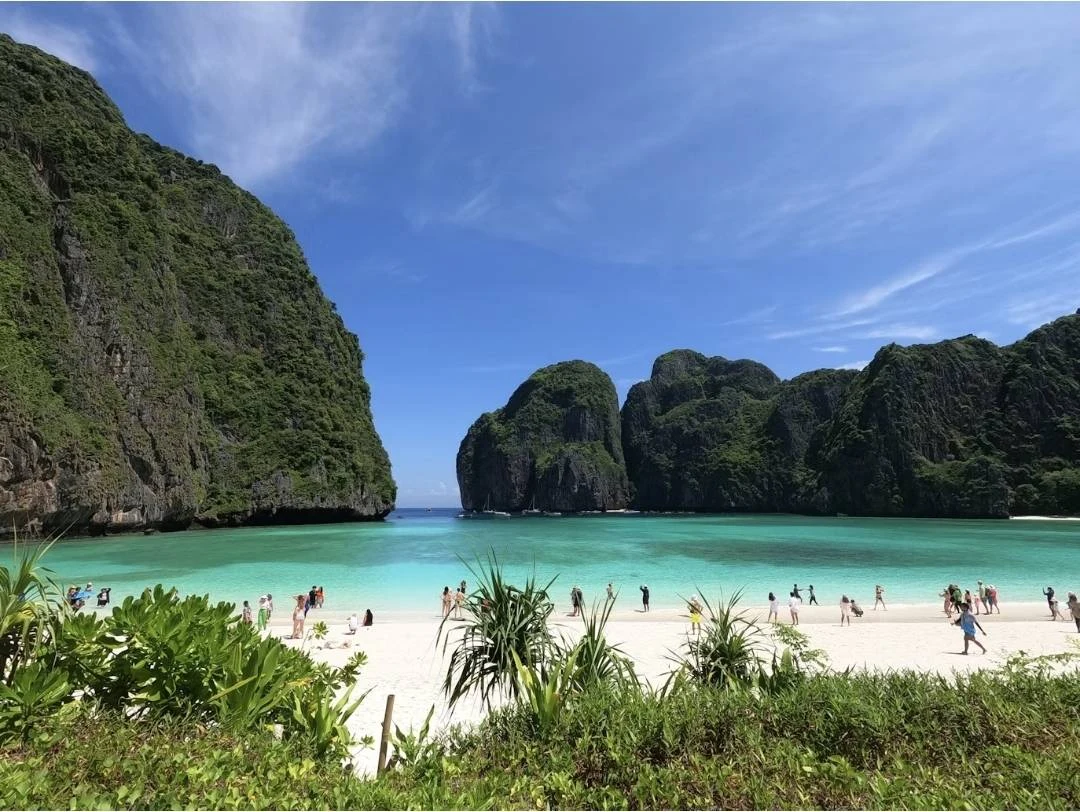
Look at the water now. That turquoise is not a filter. Blacktip reef sharks came back to the shallows. I watched one cruise the edge of the crowd like it owned the place.
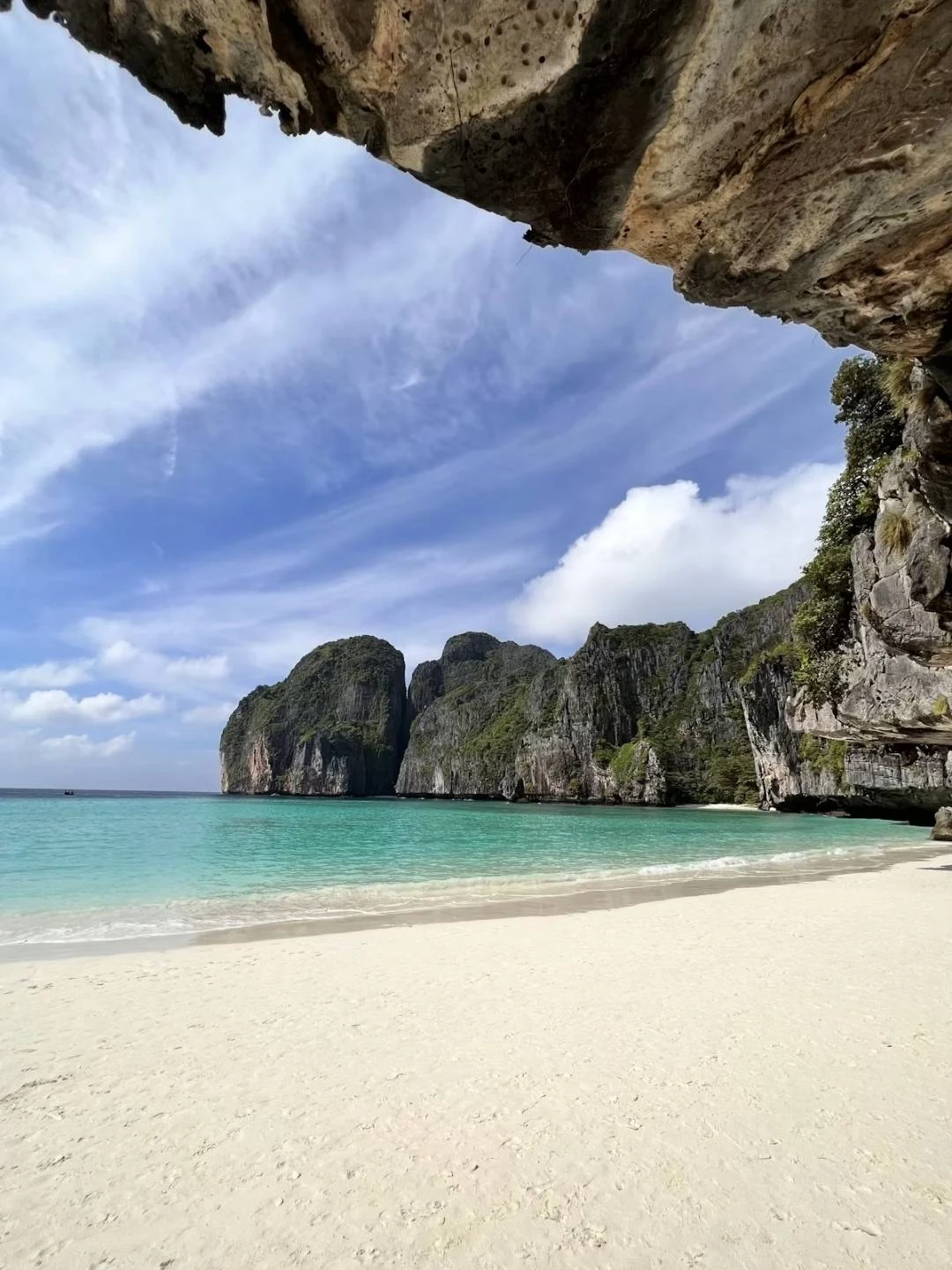
Two frames from today: the beach from above, and one quiet corner under the rock where the sand was still untouched.
The most photographed beach on earth almost got loved to death. What saved it was being left alone.
Heads up: the prices and times in this guide are my estimates, not receipts. The venues are real, but check current hours and prices before you go.
If you have ever envisioned the ultimate tropical utopia—a place of such staggering, impossible beauty that it borders on the cinematic—you have likely pictured Maya Bay. After immersing ourselves in the colorful, heritage-drenched streets of Phuket Old Town, it was time to return to the sea. But Day 27 is not just another island- hopping excursion; it is a pilgrimage to the most iconic, infamous, and breathtaking stretch of sand in the entire Andaman Archipelago. Maya Bay, enclosed by sheer, 100-meter-high limestone cliffs on three sides, is the crown jewel of Koh Phi Phi Leh.
Made globally famous by Leonardo DiCaprio’s film *The Beach*, Maya Bay suffered for years under the weight of its own mythological status. The mass tourism was devastating. But in a masterclass of ecological intervention, the Thai government closed the bay entirely for over three years to allow the coral reefs and marine life to recover. Today, it is open again, but under strict, highly controlled conditions: no boats are allowed to enter the bay, swimming is strictly prohibited, and visitors must walk in via a wooden boardwalk from the backside of the island. For an elite travel creator, this presents a thrilling challenge: capturing the pristine, resurrected beauty of an empty Maya Bay before the sun gets too high and the permitted crowds arrive.
THE LOGISTICS BLUEPRINT: DAY 27 QUICK REFERENCE
- 05:00 AM – The Pre-Dawn Marina Departure: Departing from Phuket's Royal Phuket Marina on a private, twin-engine luxury speedboat. You *must* beat the tour boats. Cost: ~18,000 THB ($500 USD) for a half-day private charter.
- 06:15 AM – Loh Samah Bay Docking: Arriving at the floating pier on the backside of Koh Phi Phi Leh as the sky turns a bruised violet. Cost: 400 THB ($11 USD) National Park entrance fee.
- 06:30 AM – The Jungle Boardwalk Transition: A brisk, five-minute walk through the lush island interior on the elevated wooden path to reach the bay.
- 06:45 AM – Maya Bay Unveiled: The golden hour photography production on the pristine, empty white sand. Zero swimming allowed; focus purely on the landscape and high-fashion editorial framing.
- 10:30 AM – Pileh Lagoon Cruise: Leaving Maya Bay and taking the speedboat into the towering emerald amphitheater of Pileh Lagoon for a mid-morning swim.
- 01:00 PM – Phi Phi Don Luxury Lunch: Docking at the larger sister island, Koh Phi Phi Don, for an elevated beachfront seafood feast. Cost: ~2,500 THB ($70 USD).
DEEP DIVE: THE ECOLOGICAL RESURRECTION OF A MASTERPIECE
Stepping out from the jungle canopy and seeing Maya Bay for the first time is a visceral, emotional experience. Because boats are no longer allowed to drop anchor inside the bay, the water has returned to a state of absolute, glassy perfection. It transitions from a clear, crystalline shallows into a vibrant, glowing neon turquoise, eventually plunging into the deep sapphire of the Andaman Sea. The silence is profound, broken only by the gentle lap of the tide against the powdery white sand.
The most spectacular triumph of Maya Bay’s closure is what lies just beneath the surface. As you stand on the shoreline, if you watch the shallow water closely, you will see the distinctive, dark dorsal fins of juvenile blacktip reef sharks patrolling the shoreline. Dozens of them have returned to the bay to use it as a safe nursery. This is why we don't swim here. We are no longer consumers of this environment; we are privileged observers of nature healing itself. The sheer vertical cliffs that enclose the bay are draped in prehistoric jungle foliage, creating a natural cathedral that makes you feel incredibly small and infinitely grateful.
"We are no longer consumers of this environment; we are privileged observers of nature healing itself.
Maya Bay is a natural cathedral that makes you feel incredibly small and infinitely grateful."
THE PHOTOGRAPHY MASTERCLASS: PRISTINE VISTAS AND STRICT RULES
Shooting at Maya Bay today requires precision. You cannot wade into the water past your ankles (park rangers will sharply blow their whistles if you try), and you cannot fly drones. The aesthetic goal here is pure, unadulterated scale—contrasting the human form against the monumental grandeur of the empty bay.
Spot 1: The Iconic Centerline (The Wide Landscape)
The Vision: The defining shot of Maya Bay: standing dead-center on the pristine white sand, with the massive, iconic limestone karst islands guarding the entrance to the bay directly behind you.
The Execution: Arriving at 06:45 AM is critical. You want the soft, diffused morning light before the sun crests over the towering eastern cliffs, which creates harsh shadows. Use a 16-35mm wide-angle lens. Have your photographer shoot from a low angle, practically resting the camera on the soft sand. Stand right at the tide line —where the wet sand meets the dry—and gaze out toward the ocean opening. Let the sweeping curve of the bay and the colossal vertical rocks dominate the frame. The negative space of the empty water is the ultimate luxury in a world of overcrowded tourist traps.
Spot 2: The Jungle Frame (The Dramatic Reveal)
The Vision: A moody, textured shot taken from the edge of the tree line, using the dark green jungle foliage to frame the glowing blue water of the bay.
The Execution: Before stepping fully onto the open beach, stop under the canopy of the native screw pine (Pandanus) trees that line the back of the sand. Switch to an
85mm prime lens to compress the depth of field. Stand in the shadow of the trees, looking out toward the light. The camera should expose for the bright turquoise water behind you, throwing the leaves and your silhouette into a beautiful, high- contrast, moody frame. It creates a sense of discovery, as if you are uncovering a secret world.
Spot 3: The Elevated Boardwalk (Sustainable Chic)
The Vision: A high-fashion editorial shot on the new wooden boardwalk, emphasizing sustainable luxury travel.
The Execution: The wooden boardwalks built by the National Park are not just functional; they are incredibly photogenic, winding elegantly through the lush island interior. Frame the shot so the leading lines of the wooden pathway draw the eye directly to you. Use a 50mm lens with a shallow depth of field (f/1.8) to blur the dense green jungle in the background. It is a sophisticated, structural contrast to the raw sand of the beach.
THE WARDROBE STRATEGY: CINEMATIC RESORT WEAR
Because swimming is prohibited, Maya Bay is not the place for a standard bikini shot. This is an opportunity for sweeping, cinematic resort wear. You want a garment that interacts with the morning sea breeze. A floor-length, flowing silk maxi dress in a stark, contrasting color—like deep cerulean blue, vivid emerald, or a classic, crisp bridal white—will look spectacular against the muted sand and towering grey cliffs. Leave the heavy footwear on the boat; walk the boardwalk in chic, minimalist leather slides or barefoot. Accessorize with delicate, layered gold jewelry and a wide-brimmed sun hat to add a touch of timeless, old-Hollywood glamour to the prehistoric setting.
FOODIE DIARY PART I: THE SPEEDBOAT SUNRISE BREAKFAST
When your alarm goes off at 4:00 AM to beat the crowds, standard hotel breakfasts are not an option. True luxury is in the catering. As our private speedboat cut across the dark, glass-calm waters of the Andaman Sea toward Phi Phi Leh, our crew unveiled a stunning morning spread.
Sitting on the leather loungers at the stern, wrapped in a light cashmere throw against the ocean wind, we feasted on a platter of hyper-fresh tropical fruit: sliced dragonfruit, sweet Phuket pineapple, and incredibly fragrant local papaya. This was paired with a selection of warm, flaky French pastries sourced from a master baker in Phuket Old Town, and a large thermos of robust, iced cold-brew coffee made from dark-roast Chiang Mai beans. Watching the sun break over the horizon while sipping cold brew on a private charter is the absolute definition of elite transit.
FOODIE DIARY PART II: GRILLED PHUKET LOBSTER ON PHI PHI DON
By 1:00 PM, the heat of the day had fully set in, and we left the pristine, protected shores of Phi Phi Leh for its bustling, larger sister island, Koh Phi Phi Don. We docked at an upscale, barefoot-luxury beachfront resort in a quiet cove away from the main backpacker village.
We secured a table on a shaded wooden deck overlooking the water and ordered the ultimate Andaman delicacy: fresh, locally caught Phuket Lobster. Sliced in half and grilled over open charcoal, the lobster meat was incredibly sweet, firm, and basted in a rich, melting garlic-herb butter. It was served with the mandatory, fiery green seafood dipping sauce (nam jim seafood) that provided an electric shock of lime, garlic, and bird's eye chili. Paired with a chilled glass of Provence Rosé and a side of wok-tossed morning glory, it was a heavy, decadent, and deeply satisfying lunch that perfectly rounded out a morning of intense creative production.
REFLECTIVE ESSAY: THE BEAUTY OF BOUNDARIES
There is a powerful lesson to be learned standing on the shores of Maya Bay today. For years, the travel industry operated under the assumption that we had the right to consume beautiful places without limits. We anchored boats on fragile reefs, we trampled vegetation, and we prioritized the photograph over the preservation.
The closure of Maya Bay was a radical, necessary intervention. Seeing the bay today, with its glassy water, returning reef sharks, and meticulously maintained boardwalks, proves that nature is incredibly resilient if we simply give it space to breathe. As content creators, we wield significant influence. When we visit places like this, we have a profound responsibility to model sustainable, respectful travel. Maya Bay is more beautiful today with its strict rules than it ever was in the era of unrestricted access. It reminds us that true luxury isn't about having access to everything; it is about respecting the boundaries that keep the magic alive.
Looking Ahead: Day 28 Preview
Tomorrow, we dive back into the water. We are trading the white sand for the towering, enclosed limestone walls of Pi Leh Lagoon. Get ready for deep emerald water and ultimate aquatic luxury.
Xo, Lexi